The bevel junction is an open problem
The sharp bevel is a global map from sites to points #2H7DL8
LUFT's refounded chamfer has an unusually strong regularity. A canonical edge or vertex site s, its occupancy star, and the width w determine one point
An oriented face does not invent that point. It merely includes the same G(s) as every other face incident to the site. The CPU classifies four edge stars and four vertex stars into one 32-bit shape word; the vertex shader decodes those decisions and realizes sixteen points on the same 4 by 4 patch for every face. Fixed positive and negative index templates draw eighteen triangles. #RUAWR5 explains the displacement rule and its closure tests.
This is correct by construction in a specific sense: incident faces agree, the surface is watertight without stitching, cubical transforms preserve the rule, and CPU decisions have one continuous realization at the live width. It is also inherently a sharp-miter system. If several chamfer strips meet at one lattice vertex, they all have exactly one G(s) at which to terminate.
That limitation is honest and local. The ordinary convex and concave bevel geometry keeps its coherent structure; only a mixed junction asks for a codomain richer than one point.
Mentioned in: Every vertex is an offset-line intersection
A miter arc carries the band; it does not decorate a singularity #DJK8HW
Three user-supplied screenshots preserve the visual argument. The first is
the original LUFT junction, deliberately zoomed and framed on the problem:
the green chamfer strip loses its width and collapses into the one shared
point.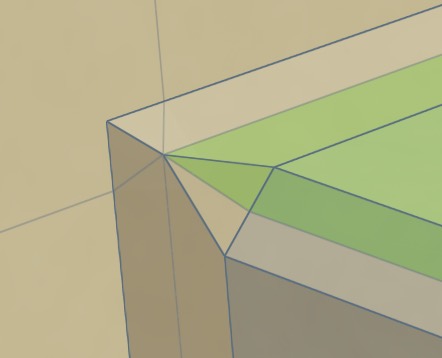
The second is the first attempted repair. Extra points do not carry the
strip around the corner; they enlarge the old singularity into a conspicuous
pinwheel of skinny triangles.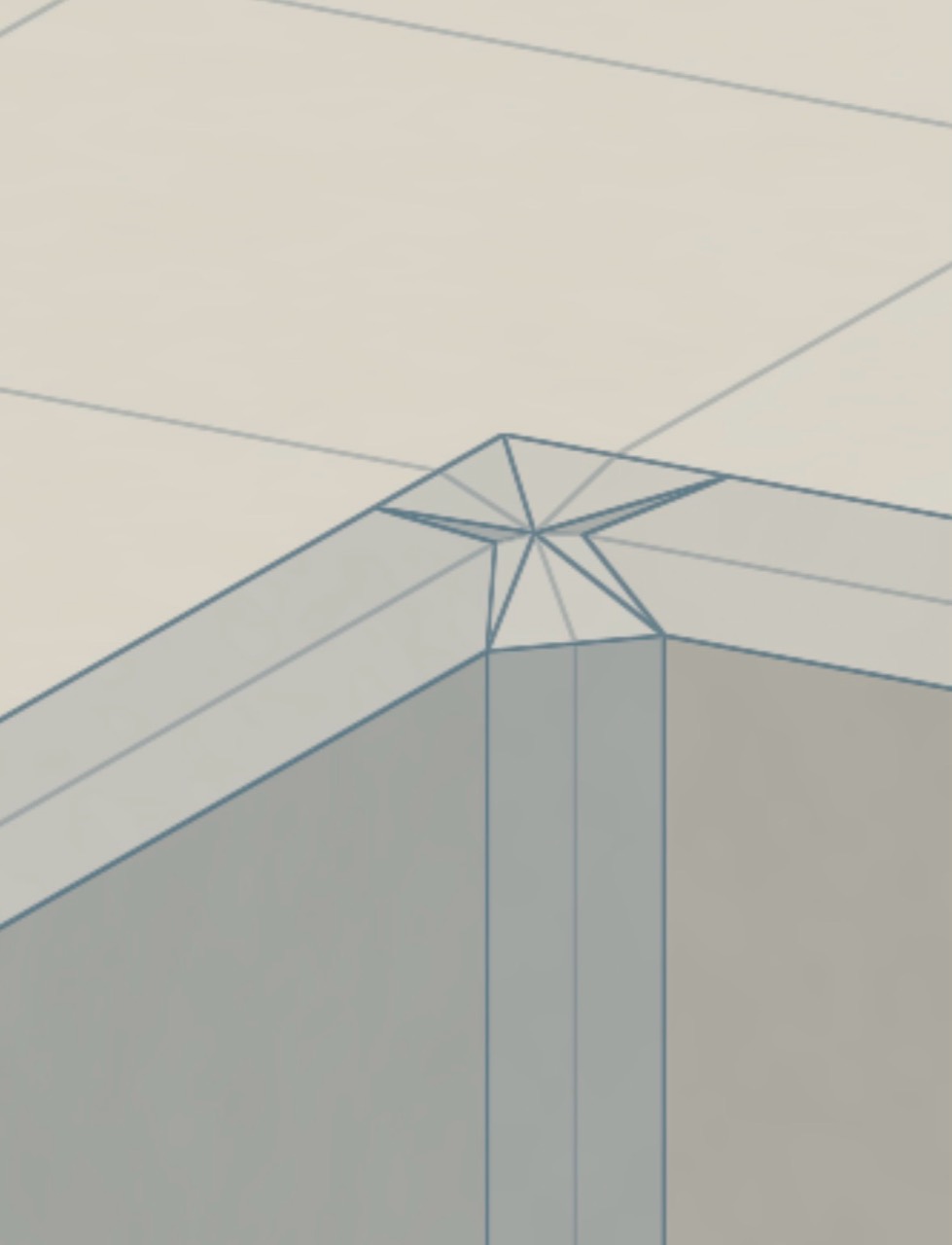
The third is Blender's Bevel modifier with Outer Miter set to Arc. It is
an independent visual oracle, not a requirement to copy Blender's mesh
representation. Broad bevel bands turn through the mixed junction without a
central star, a sliver fan, or a strip narrowing to a point. Blender's
bevel documentation describes the Arc choice as two vertices near the
meeting joined by a curved arc.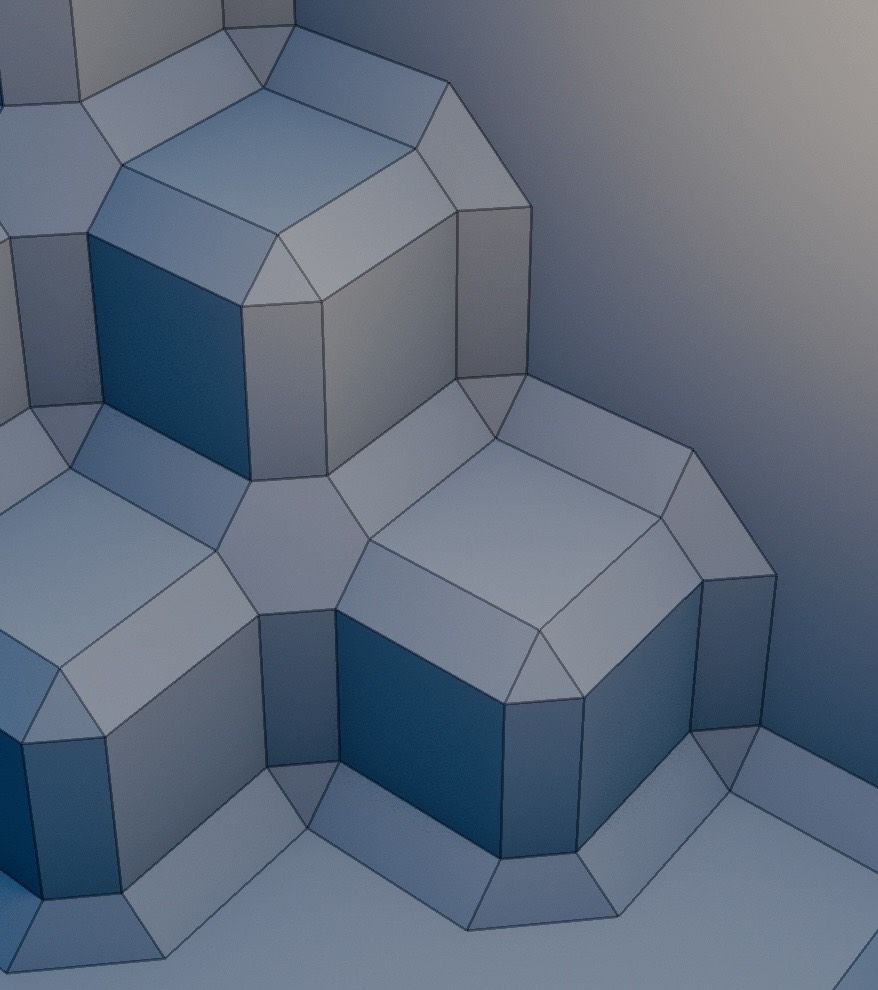
The transferable requirements are relational: approximately constant band width, an ordered turn, and a crease graph which follows the band. A broad architectural plate such as #Z5NDTA supplies context, but it cannot replace the user-framed closeup as evidence.
Mentioned in: The miter family portrait keeps the awkward stars in context, The minimal-arc transition crossed the architecture halfway, Every vertex is an offset-line intersection, Turn, don't die: sharp miters leave a (3,1,1) fingerprint, Blender's Arc bevel is an executable oracle, Implement the site-stream LUFT renderer backbone
Referenced from code: Build the wall-side stepped mountain used to judge mixed miters. #Z5NDTA The two L-shaped terraces retain five-, six-, and seven-cell vertex stars in
one architectural context. Their back edges meet a continuous wall so the
same view also retains the truncated wall miter preserved by #DJK8HW. One isolated terrain cell makes the ordinary boulder-on-ground contact
inspectable beside the architectural mixed-miter cases. The lower L supplies the outie, straight six-cell run, innie, and the
first wall termination. The upper L repeats them without isolation.defun make-miter-study-scene render.lisp:469 ↗
The minimal-arc transition crossed the architecture halfway #RJ0RLN
Commit 4724734 tried to move from the sharp junction to an Arc-like one while retaining a fixed face patch. It made two changes which need to be judged separately.
The useful representational observation was that one compact corner direction cannot describe several directed endpoints around the same vertex. The commit therefore replaced the CPU-authored edge and corner conclusions in the shape word with four complete eight-cell stars. It expanded every face from sixteen to twenty-four implicit points by adding two half-edge points at each corner, and from eighteen to twenty-six triangles.
But this also partly reversed the refoundation's CPU/GPU boundary. Before the commit the CPU classified occupancy and the shader decoded the answer. After it, the shader again counted occupancy, computed minority moments, projected half-edge stars, recognized miter configurations, and selected point formulas. The CPU still extracted a bounded neighborhood into a 16-byte record, so this was not a return to arbitrary shader-side world reads, but discrete bevel meaning had moved back into every vertex invocation.
Most importantly, the topology did not make the same transition as the point data. Directional endpoints were inserted into the old face-owned patch and triangulated back to its shared centre. The representation wanted a coherent vertex junction; the indices still described a centre-oriented face fan. The visible pinwheel in #DJK8HW is that mismatch, not a small tuning error.
LUFT has therefore returned to the sharp baseline. The failed transition is kept as evidence rather than retained as latent complexity in every ordinary face.
Mentioned in: Turn, don't die: sharp miters leave a (3,1,1) fingerprint, Faces, bands, and fans: three instance streams
Structural proofs implemented the rejected specification faithfully #7LEM72
The minimal-arc experiment remained watertight, preserved shared incident-face positions, transformed over the cubical symmetry group, produced consistently wound nondegenerate triangles, and agreed between independent CPU and shader arithmetic to floating-point tolerance. Those checks established that the program implemented its specification.
They did not establish that the specification was an Arc bevel. None asked whether a strip retained its width, whether the crease graph contained an unexpected high-valence centre, or whether the triangulation formed slivers. The rendered closeup rejected the result immediately.
This separates three claims which future work must not conflate:
- the records and triangles are combinatorially valid;
- CPU and GPU realize the same formulas; and
- the formulas and connectivity express the intended bevel.
The first two remain necessary engineering evidence. The third needs an independent geometric oracle and human inspection. Exhausting all 256 stars cannot rescue a predicate which never states the visible requirement.
Mentioned in: Every vertex is an offset-line intersection, Blender's Arc bevel is an executable oracle
The sharp baseline remains inspectable at the problem scale #L7N4MO
The miter study of #Z5NDTA retains the exact #xCD wall termination alongside
five-, six-, and seven-cell junctions. Two named captures use the production
renderer, the normal 0.11-cell chamfer width, one camera, and construction ink
as the only changed variable. They are diagnostic fixtures, not approved
goldens.
Mentioned in: Implement the site-stream LUFT renderer backbone
Referenced from code: Capture the #xCD wall termination at the normal chamfer width. #L7N4MO At this yaw/pitch the camera lies backward from the motivating
vertex (12,8,3), placing that exact join at frame centre.defun capture-luft-miter-closeup luft-portraits.lisp:457 ↗
The sharp junction with its construction edges #78WA2W

The same sharp junction without diagnostic ink #6X0WRV

A larger local object may preserve the old system's regularity #GBCLEV
The known constraint is small: one point cannot represent a band entering and leaving a mixed vertex at distinct locations. It does not yet determine the right replacement. Several questions remain open:
- Is the geometric value at a vertex a cyclic boundary, a filled patch, or a small topology identifier whose realization remains fixed and implicit?
- Can ordinary faces keep the sixteen-point sharp path while only exceptional vertex stars publish junction records, avoiding a universal per-face cost?
- Should the CPU publish explicit miter decisions, as the refoundation intended, or is some bounded star interpretation genuinely better in the shader?
- Are outer and inner miters complements of one rule, or distinct policies as Blender's vocabulary suggests?
- What independent construction defines constant width and angular order over the relevant cubical stars before triangulation is chosen?
- Can all required junctions be selected from the finite 256-star alphabet without turning the table itself into an unexplained collection of pictures?
A promising design would generalize the gluing invariant rather than abandon
it: every incident face derives the same ordered boundary from the same
canonical vertex star, and the junction owns whatever fills that boundary.
That is a consequence of the failure, not yet a selected implementation. Intent. Understand whether an Arc-like mixed miter can preserve LUFT's
site-local ownership, CPU-authored discrete geometry, bounded records, and
fixed dense rendering without complicating every ordinary sharp bevel. Evidence. Closed by the offset construction recorded in
The beveled surface is a sum over sites. What was
observed: every vertex the junction needs is an intersection of offset
lines and therefore an integer lattice point (#IQC0Y4); the junction
boundary and its constant-width criterion are defined by those
intersections independently of any triangulation, and the fill is a fan of
k equilateral w-tiles with k the band's turn in units of 60° — the
wall-end flare is three tiles forming a half-hexagon trapezoid, the
staircase saddle six forming a flat regular hexagon (#EUZLR8). The
one-point collapse and the pinwheel are both rejected algebraically: sharp
miters emit triangles with normals of type (3,1,1), outside the
\{100\}/\{110\}/\{111\} alphabet, wherever a band dies (#GT4Y9J), while
the Arc policy keeps every normal in the alphabet and every vertex integer,
verified across six voxel fixtures with Blender's Arc bevel as an exact,
integer-diffable oracle (#WK4YU4) — the independent oracle this mark asked
for, stronger than the closeups it anticipated. The work grain is stated
in #8UGGY0: ordinary faces keep a single quad, bands are per-edge
instances, junction fans are per-vertex instances, so the ordinary face
cost is unchanged. Implementation is selected as #RO2OCL, with the
exhaustive star sweep as #WJRRK7. Mentioned in: The miter family portrait keeps the awkward stars in contextDONE Find a regular site-owned account of mixed bevel junctions #2PN62B
()Build the wall-side stepped mountain used to judge mixed miters. #Z5NDTA The two L-shaped terraces retain five-, six-, and seven-cell vertex stars in one architectural context. Their back edges meet a continuous wall so the same view also retains the truncated wall miter preserved by #DJK8HW.
(&key (horizontal-bits 6) (origin-x 0) (origin-y 0))(builder x0 x1 y0 y1 z0 z1
&key (solid-p t) architecture-p
(material (if architecture-p *sanctuary-material-placement*
*terrain-material-placement*)))(builder x y z &key (solid-p t) architecture-p (material nil material-p))(builder &key player-p)(pathname wireframe title)Either :PERSPECTIVE or :ISOMETRIC. An isometric picture has no vanishing point, so two chamfers the same width are the same width on screen wherever they sit. That is what makes it the projection to judge a shape rule in.
How many world units of height an isometric frame spans.
Global construction-edge strength. The atelier toggles it between 0 and 1.
Whether a ray hit gets a blueprint reticle and local triangle-edge lens.
(&key
                       (solid (make-mountain-sanctuary-scene))
                       (bevel-width 2)
                       bevel-profile
                       surface-mesh
                       (camera (make-fly-camera))
                       (title "LUFT — click to walk · scroll to zoom · M orbit")
                       (width 1100) (height 800)
                       fullscreen-p
                       (inspector-p nil)
                       (frames-per-second 60)
(provider *gpu-provider*))Open the indexed-instanced LUFT renderer as a McCLIM atelier. BEVEL-PROFILE enables the experimental material-selected width cohorts for a non-streaming scene. BEVEL-WIDTH remains the camera/inspection reference and the uniform fallback. SURFACE-MESH supplies an already constructed diagnostic mesh while retaining…
Default bevel width in eighth-cell integer ticks (one quarter cell).
(&key (position
            (vec3:make-vec3 (+ 70.0 +sanctuary-origin-x+)
                            (+ -18.0 +sanctuary-origin-y+) 50.0))
          (yaw 2.2455373) (pitch -0.5165006)
(field-of-view 0.9599311))(x y z)(pathname &optional (viewer *viewer*)
&key (inspector-p (viewer-inspector-p viewer)))Render one native-resolution VIEWER frame offscreen into PATHNAME. INSPECTOR-P defaults to VIEWER's inspector setting. A source-defined evidence capture may override it when the subject is the geometry rather than the atelier UI.
(&optional (viewer *viewer*))Stop VIEWER exactly once and publish one result to every caller. Native canvas-thread handlers use REQUEST-VIEWER-QUIT instead: a synchronous owner or waiter is rejected there because teardown crosses a frame boundary.
The refounded indexed chamfer is the planar case of #6TEFOS. Every canonical edge or vertex site reads its complete occupancy star, chooses the strict minority, and reduces that minority's moment to a signed direction q. Convex creases therefore move toward minority solid cells, concave creases toward minority air…
The sharp system's site map #2H7DL8 sends a site to one point G(s). The generalization that resolves the mixed junction of #DJK8HW is not a richer mystery object: it is the observation that every vertex the bevel ever needs is an intersection of offset lines — axis-aligned lattice lines displaced by the bevel offset…
There is exactly one corner primitive: the equilateral triangle of side w lying in a body-diagonal \{111\} plane. A junction vertex is filled by a fan of k such tiles, where k is the turn the skirt boundary makes there, in units of 60°: The trapezoid has legs w, near base w, far base 2w — three tiles in a strip,…
The policy decision the miter study was circling (#DJK8HW, #RJ0RLN) has a crisp algebraic form. Observed in Blender (cell 4, offset 1), sweeping every face normal of six voxel test objects against the 26-direction alphabet: – With the default sharp outer miter, every terrain grows isosceles triangles with edge…
Because all vertices are integers, Blender stops being a visual reference (#DJK8HW) and becomes a specification that can be diffed exactly: build a star as a voxel mesh, apply the bevel modifier (offset m, one segment, Arc outer miter), and compare vertex sets and face census against the tables. A first sweep of this…
The renderer paradigm this fixes: the mesh is not a property of cells — a cell's relevant neighborhood is 26 cells, whose configuration space is astronomically large and whose geometry is shared anyway — it is a sum over sites, each drawn as an instance of a fixed template: – Face sites: every exposed cell face emits…
Intent. Rebuild LUFT's surface rendering on the decomposition of #8UGGY0: integer lattice cells (a=8, m=1 to start), three instance streams with fixed templates, CPU-side star classification into per-site records, and turn-don't-die junctions per #GT4Y9J. Evidence. The offset construction and tile alphabet are…
Intent. Build the vertex-star table that #8UGGY0's fan stream reads: for each regular star, derive the incident bands, their offset-line intersections, the turn count k, and the tile fan entirely in integer arithmetic. Separately choose whether singular stars are rejected, split into regular surface sheets, or given…
The shared-point rule of #RUAWR5 is compact and watertight, but it gives every incident chamfer strip only one place to end at a mixed vertex. At the wall-side step this truncates a strip which should continue around the meeting: the long miter collapses into a narrow triangular fighter shape. That is the coherent…
Three user-supplied screenshots preserve the visual argument. The first is the original LUFT junction, deliberately zoomed and framed on the problem: the green chamfer strip loses its width and collapses into the one shared point. images/luft-miter-initial-collapse.jpg The second is the first attempted repair. Extra…
The miter study of #Z5NDTA retains the exact #xCD wall termination alongside five-, six-, and seven-cell junctions. Two named captures use the production renderer, the normal 0.11-cell chamfer width, one camera, and construction ink as the only changed variable. They are diagnostic fixtures, not approved goldens.
Broad plinth and continuous back wall.