LUFT: packed sites, chains, and the atelier
LUFT is a small complement to luv: a way of naming the vertices, edges, faces,
and cells of a cubical world with one fixnum each, and of treating a block
world as algebra rather than as voxels with decorations. Its first client
is a greenfield renderer, an atelier free of the luvcraft mesher, that draws
a textureless block world from shaders reading those fixnums straight from a
GPU buffer by vertex pulling. This page records the vocabulary, the algebra
that makes the surface fall out, the shader-language extensions the GPU path
needed, and the shape of the atelier. Its temporal frame graph now has a page
of its own: Temporal reconstruction in the Luft atelier. A site is a 60-bit unsigned value: three extent bits Incidence is canonical: the high X boundary of the cell at The oriented boundary follows from the ordered axes in the extent: the high
boundary along the Mentioned in: A block world is a 3-chain and its surface is a boundary, How a cell says which stock it is A luft:chain is a collection of signed sites. Its implementation is
a pair of hash-table ledgers, one per polarity, both keyed by geometry with the
polarity bit masked away. Adding a site annihilates one opposite site already
in the other ledger. Private occurrence counts make that result independent
of arrival order; an ordinary solid and its surface still contain at most one
copy of any signed site. A solid world is the 3-chain containing one positive site for every occupied
cell. Its visible surface is not a meshing problem but an algebraic fact:
luft:boundary-chain applies #KE4P5F's oriented boundary to every
site. Two solid neighbours send their shared face to opposite polarity
ledgers, so the pair annihilates; only exposed signed faces survive. A face's
polarity reverses or preserves its canonical orientation to give its outward
normal, and The luvcraft mesher walks chunk fields on the CPU and emits atlas-textured
quads (see the block world); LUFT's
luft:surface-chain is a pair of polarity ledgers holding signed face
sites. Both are right for their worlds; the second lets a GPU invocation
reconstruct a face without a CPU vertex product. A surface face is already one signed 60-bit site, with no separate wrapper or
coefficient encoding. It remains an immediate fixnum on 64-bit SBCL, and a
specialized vector of sites can be copied directly into the
The four buffer bits above the site now carry the stock of the solid cell
behind the face. The chain itself still owns only the low sixty bits; stamping
happens on the copied GPU product after its geometric ordering is complete
(#PWMCOL). Mentioned in: The mesh-shader experiment found a budget, then ended, Vertex shaders are the one terrain path, Compact surviving faces only when measurement earns another path The mathematical shader language of #S4H8DR had textures, samplers, and a
vec4-only uniform block, and no way to read an array of 64-bit words. Two
additions carry a site into a shader: Both are raw representations until interpreted: they carry no quantity, so an
unannotated graph stays valid legacy source and an annotated one still
refuses to mix. The Metal HAL gained the matching Referenced from code: One descriptor-backed read-only array of uniformly typed elements. The array has no declared length: a shader indexes it with The first GPU path had task and mesh stages and no vertex buffer. A task
workgroup owned a small brick, culled its bounding sphere, and handed the brick
index through a payload. Mesh lanes loaded signed sites, unpacked anchor,
extent, and polarity, and emitted their vertices and triangles. It proved the
central representation claim of #AGVXGM: the boundary operator's orientation
can be rendered directly from its packed site. Rounded faces made that brick size a hardware contract rather than merely a
batching choice. One 6×6 face grid emitted 36 vertices and 50 triangles, so a
five-face group declared 180 vertices and 250 primitives, inside
The path then stopped earning its duplication. Lavapipe executed it slowly;
the project's RX 6600 XT advertised the extension and did not execute it
reliably; and the ordinary vertex path below drew every style on Vulkan and
Metal. Keeping a non-default technique meant two shader implementations, two
sets of scene resources, technique dispatch, and an environment switch for a
mode nobody should select. Luft removed the runtime mode, brick data, task
payload, mesh definitions, and their pipelines. The experiment stays here as
design evidence, not as dormant source. The fragment stage is textureless by design: a top, side, and bottom tone,
a soft line where faces meet, sun and ambient light, and fog toward the sky.
The whole atelier is The standalone atelier still permits semantic reduction.
Mentioned in: Compact surviving faces only when measurement earns another path The renderer draws K vertices per site with no vertex buffer at all.
Each vertex shader invocation divides its built-in index by K to find its
site in the very same The chamfer of #RUAWR5 is the same grid at fifty-four vertices a face: nine
quads of the 4×4 point lattice, each split along the diagonal toward its
nearest corner. A vertex is one point and needs only the star of its own
nearest corner: six cells
beside the face's solid and air cells, across U, across V, and across
both, toward that corner's side. The site rules of #6TEFOS then move it --
corner star at a corner, edge star along a boundary, nowhere inside -- and
because every face incident to a site gathers the same star, the facets meet
exactly. The rounding of #6TEFOS is the same
again at two rings and a hundred and fifty vertices a face: the vertex's own
grid position says whether it is a shared corner, a ring point, or an inner
point, and the rules BEVEL-POINT-BINDINGS generates per point are chosen at
run time from the same six-cell star. The watertightness test that was
Metal-only now runs on Linux over every style. The vertex shaders live
in Rounding a crease is not something either face beside it can decide alone,
and in LUFT it does not have to be: the crease is an edge site, its four
surrounding cells are its star, and a vertex site has eight. The star's
solidity classifies the crease — flat, convex, concave, or saddle — and one
rule places the shared point: move toward the star's minority (the lone
solid cell of a convex crease, the lone air cell of a concave one) so that
the point lands on the sphere or cylinder of radius r centred at
\text{site} + r\,q, where q is the minority direction clamped to unit
components. For edges that is the fillet cylinder point at r(1-1/\sqrt2),
for corners the sphere point at r(1-1/\sqrt3), zero on flat and saddle
stars, and a vertex in the middle of a crease run agrees with its edge, so
creases stay straight. Because every face incident to a site computes that point from the same star,
subdivided faces meet exactly and the surface is watertight without stitching
or corner patches. Mentioned in: Vertex shaders are the one terrain path, Small planar facets soften convex and concave creases, Rounding is the half-level set of the smoothed occupancy, The lattice need not be square, The distance codomain was tried, and argued against itself, Clay: the golf ball, a field that is its own definition The refounded indexed chamfer is the planar case of #6TEFOS. Every canonical
edge or vertex site reads its complete occupancy star, chooses the strict
minority, and reduces that minority's moment to a signed direction q.
Convex creases therefore move toward minority solid cells, concave creases
toward minority air cells, and balanced stars do not move. The decision is a
property of the shared site rather than of any incident face, so the realized
surface remains watertight without stitching. luft:site-displacement places the shared point at
w\rho q. Ordinary creases use the half reach \rho=\tfrac12; a vertex
whose raw moment is a unit cube diagonal uses the centroid reach
\rho=\tfrac23. Each oriented boundary face carries the resulting edge and
corner decisions in one shape word. The GPU realizes sixteen implicit points
on a 4 by 4 patch and draws its fixed eighteen indexed triangles. The current
default luft.render:*chamfer-width* is 0.11 cell. The fragment shader recovers each planar facet normal from screen derivatives
of world position. A 21-bit construction mask records only those edges of
the fixed patch whose adjacent realized triangles actually turn, so the
blueprint view reveals the geometric decision without drawing every hidden
diagonal. The CPU reference and shader realization are compared point for
point in the renderer tests. Mentioned in: Vertex shaders are the one terrain path, The miter family portrait keeps the awkward stars in context, Rounding is the half-level set of the smoothed occupancy, A world knows what it is cut from, The lattice need not be square, A chamfer belongs to the crease, not to either face, What the watertightness test caught, The distance codomain was tried, and argued against itself, Clay: the golf ball, a field that is its own definition, The sharp bevel is a global map from sites to points, Every vertex is an offset-line intersection, Faces, bands, and fans: three instance streams The shared-point rule of #RUAWR5 is compact and watertight, but it gives every
incident chamfer strip only one place to end at a mixed vertex. At the
wall-side step this truncates a strip which should continue around the
meeting: the long miter collapses into a narrow triangular fighter shape.
That is the coherent sharp-miter construction reaching the boundary of what
one shared point can express, not a crack or an inconsistency in its ordinary
bevel geometry. An isolated seven-cell star at =w=0.20 made the defect look grotesque and hid
its architectural scale. luft.render:make-miter-study-scene instead
builds a small Minecraft mountain against a continuous wall at the honest
default =w=0.11. One orthographic plate then retains the triangular innie and
outie, the six-face hexagonal block party, and both wall terminations of the
truncated fighter miter. The scene is topology, not a hand-authored mesh: a
regression checks that its five-, six-, and seven-cell vertex stars and its
terrace-to-wall occupancy remain present. The image is a named The attempted transition, the rejected pinwheel, the Blender comparison, and
the representation questions they expose now live together in
The bevel junction is an open problem. #DJK8HW keeps
the closeup as primary evidence; #2PN62B deliberately remains an idea rather
than the next implementation step. Mentioned in: The studio: a world of stars under the same cameras, A miter arc carries the band; it does not decorate a singularity, The sharp baseline remains inspectable at the problem scale, Every vertex is an offset-line intersection, Implement the site-stream LUFT renderer backbone Referenced from code: The canvas loop owns another thread, so configure its global
renderer state before it starts rather than dynamically binding
these specials around Build the wall-side stepped mountain used to judge mixed miters. #Z5NDTA The two L-shaped terraces retain five-, six-, and seven-cell vertex stars in
one architectural context. Their back edges meet a continuous wall so the
same view also retains the truncated wall miter preserved by #DJK8HW. Broad plinth and continuous back wall. One isolated terrain cell makes the ordinary boulder-on-ground contact
inspectable beside the architectural mixed-miter cases. The lower L supplies the outie, straight six-cell run, innie, and the
first wall termination. The upper L repeats them without isolation. The star rules of #6TEFOS place each shared point by classifying its eight
cells, and the studio of #UTRJ2T shows where that runs out: a block standing
on a floor, a bar's foot, any mixed corner where a convex crease meets two
concave ones. There the vertical fillet flares into a skirt and the floor's
points and the block's points, placed by different cases, fold into each
other (left column above). The Smooth the solid's indicator with a tent kernel of half-width R along each
axis. The result F is the fraction of solid under the tent: one deep
inside, zero in open air, exactly one half on a flat wall, and C^1
everywhere because a tent integrated against a step is a quadratic ramp.
The rounded solid is the set F = \tfrac12. Every grid point of every
face, boundary or inner, takes three Newton steps onto that set along
\nabla F, and the surface normal is -\nabla F. Faces incident to a site
agree without any stitching because the projection is a function of position
alone; a convex crease becomes a fillet and a concave one a cove of the same
reach R; and a mixed star becomes whatever smooth blend the field makes of
it, which is always one surface. With R \le \tfrac12 the tent overlaps
two cells along each axis, so F and \nabla F cost eight cell reads each,
the price of a trilinear sample ( The fragment stage reads the same field at its own world position and takes
its normal from the gradient there, so the rounding shades smoothly however
coarse the grid -- so smoothly that the Mentioned in: The same field read as a drawing, A world knows what it is cut from, The lattice need not be square, The distance codomain was tried, and argued against itself, Clay: the golf ball, a field that is its own definition A line drawing of a block world is its creases, and the field of #TI9NJP
knows where those are without any edge detection: wherever the smooth normal
has turned away from the face normal. The The indexed atelier revives the useful part of this reading at #UWRDQI, but
with a sharper meaning. The CPU compares the normals of the two realized
triangles incident to each internal edge and records only genuine turns; the
fragment's derivatives decide pixel width, never whether an edge exists. A
global construction mode draws that topology, while the pointer contributes
only a precise reticle and a small lens onto the otherwise hidden triangle
mesh. Every style up to here shaded the world in one substance -- turf above,
earth at a cut, dark underneath -- because a face's direction was the only
thing a fragment knew about the matter behind it. That is enough to read a
solid and not enough to read a building. A stone pier and an oak deck
differ in colour, in figure, in how they take a highlight, and above all in
what their planed arris does with the light: the chamfer on a mahogany board
is paler than its face because the cut crosses the fibre, and the chamfer
on a bronze rail is brighter than its face because a handled edge
polishes. A luft.render:material is therefore not a shader. It is a short
list of numbers -- three albedos, a finish, a grain, a mottle, a way of
weathering -- and adding a stone is editing a table. The Three procedurals do most of the work, and they are three different kinds
of thing. A grain is growth: wood gets its figure from a bundle of pith
lines running along an axis on a loose lattice, and the point's distance
from the nearest pith, jittered per trunk and warped by a slow turbulence,
is banded into rings. A face cutting across the axis therefore meets the
rings as circles and a face along it as the long streaks of a sawn board,
and nothing has to be told which it is
(luft.render.shaders::stock-grain); the same code with the rings
nearly off and the wander far up is the veining of marble. A mottle is
simply patchiness at the scale of a cell or two, which is what a stone
wants. A bond is neither: it is a way of putting a wall together, and
luft.render.shaders::stock-courses reads the bed joints off Z, the
perpends off the face's own horizontal, and staggers them half a brick each
course, which is the whole of what a stretcher bond is. A metal is a fourth case again. Bronze gets the hemisphere about its
mirror direction and almost no diffuse, which is what makes it read as a
metal rather than as brown paint with a white spot on it; the weathering
measure of the field then puts verdigris in every hollow and leaves every
ridge polished. Mentioned in: Clay: the golf ball, a field that is its own definition A LUFT site occupies sixty bits and travels to the GPU in sixty-four, so
four bits are free above it (#KE4P5F). The packed site spends them on which
stock the solid behind the face is cut from: sixteen materials in a world,
at no cost in bandwidth and none in a second lookup. A
luft.render:world is a chain together with one stock slot per cell,
and building code does not pass the material about -- it binds luft.render:refresh-scene stamps each surface site from the cell it
bounds after the geometric sites are ordered, since past bit sixty a packed
site is no longer a LUFT site and nothing may read it as one. The sixteen
stocks' numbers travel in a storage buffer of their own,
luft.render:stock-table-data, nine vec4 lanes apiece, rewritten
every frame because the whole table is only a little over two kilobytes. Mentioned in: The GPU reads signed sites directly Setting eleven specials by hand is not how anyone chooses a time of day, so
a luft.render:light names a set of them together and Mentioned in: Five pieces and a sheet of stocks A cube world's reputation for making only boxes is a reputation for having
no vocabulary. A round-headed opening is a column of cleared cells whose
height follows a circle; a tower is a disc repeated up Z; a corbel is a
course that oversails the one below. Each is a dozen lines of
luft.render:carve-arch cuts the opening -- a rectangle up to the
springing, closing above it on z = \sqrt{r^2 - x^2} rounded to cells --
and luft.render:ring-arch lays the voussoirs just outside that
curve and brings them down as jambs, so a limestone wall can carry a granite
arch and the opening reads as built rather than as punched.
luft.render:fill-disc, luft.render:fill-ring,
luft.render:corbel, luft.render:crenellate, and
luft.render:spiral-stair are the rest of the mason's kit. The
grid's own staircase is not a defect to be hidden: the chamfer gives every
step of an arch ring a facet that catches the light differently, which is
what a voussoir does. The same three lines carve a doorway and a cave mouth; only the radius
differs. Above, a fourteen-cell opening cut through the two courses of
granite left standing at the face of a massif, ringed in limestone, with
the rock of the hall behind it left as columns. Mentioned in: Open the phone-first gallery Referenced from code: Reproducible The canvas loop owns another thread, so configure its global
renderer state before it starts rather than dynamically binding
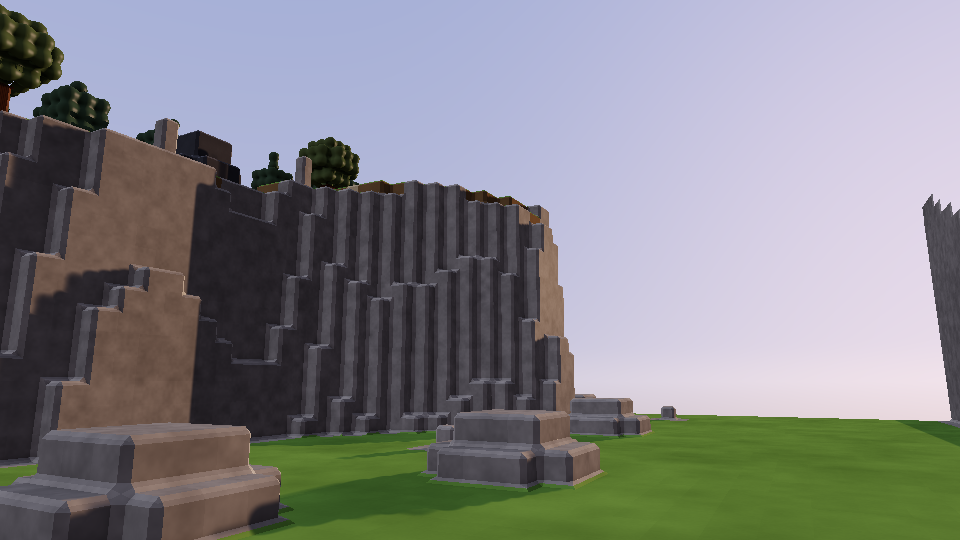
these specials around For landscape, one rule does most of the work.
luft.render:lay-ground fills the whole floor as rock and decides
nothing about what grows; luft.render:grass-the-flats then repaints
the top cell of every column that is within a cell of all four neighbours.
A cliff therefore comes out bare and its top a field, which is the whole
difference between a terrain and a landscape, and the soil colour on the
side of a one-cell turf clod becomes the brown line under every green ledge. The corollary is that a cliff must fall in about one cell of plan per many
of height. A face that falls three cells for every one it steps in is not
a cliff but a flight of steps, and the slope rule will turf every tread of
it; eight per one is a cliff with ledges. Terrain functions here are
written with that in mind. luft.render:atelier-scene and luft.render:atelier-cameras
are generic functions on a piece's name, so a sheet can ask for all of them
without knowing any of them and a new piece is one method and one entry in
luft.render:atelier-pieces. There are eight: The holm is a rock island with a walled town on it and a bridge out to the
shore: a coastline from the slope rule, a bridge of two arches on piers
standing in the channel, a ramp cut up through the cliff, a curtain wall
with a round-headed gate between two turrets, a hall with an arcaded front,
and houses of stone below and timber above under tiled roofs -- one world,
seven stocks, and no part of it that any earlier piece did not already
teach. It is also where a mistake is easy to see: the bridge was built
running along its channel rather than across it, twice, and only a plan
view said so. Each piece carries its own cameras, because a building nobody photographs
from the right place is a building nobody has seen, and the cameras are as
much of the design as the geometry:
luft.render:render-piece-sheet puts a piece's views down one
column, luft.render:render-light-sheet crosses them with the hours
of #KG0EG6, and luft.render:render-view renders one of them as a
picture. Mentioned in: A lattice that wanders, modulated by what the cells are made of Every shaped point is placed in the lattice by a rule over its star
(#6TEFOS, #RUAWR5, #TI9NJP) and only then turned into a clip position. Put
a smooth map W between those two steps and the whole world bends, and not
one rule changes. Eight of them live in luft.render.shaders::deform-point
-- a shear, a taper, a bend about a horizontal axis, a twist about a
vertical one, a swirl in plan, a standing wave, and the whole plane wrapped
onto a sphere -- chosen by a uniform rather than by a pipeline apiece, so a
sheet can put them side by side and The surface stays watertight for exactly the reason it was watertight
before: the faces incident to a site all compute the same rest point, and
W is a function of position alone, so they all land on the same bent
point. A deformation cannot open a crack the lattice did not already
have. The bent normal follows from W by construction rather than from a
Jacobian anyone had to write down.
luft.render.shaders::deform-normal builds a frame in the rest
surface's own tangent plane, pushes its two vectors through the map a
hundredth of a cell away, and takes the cross product of the differences;
that is \det(J)\,J^{-\mathsf{T}} n for whatever map comes next, at the
price of three evaluations. The fragment stage keeps the rest position beside the bent one and looks
the lattice up there: the occupancy field, the grain, the cell's own tone
and the shadow ray all live in the lattice, and only the view -- the eye
vector, the fog, the specular -- is taken from the bent world. So the
light bends with the geometry rather than being cast across it, which for a
gentle bend is invisible and for a globe is a decision rather than a bug. The interesting map is neither smooth nor global: a noise field that shakes
the lattice loose, with an amplitude that differs from place to place. The
temptation is to take that amplitude from the cell a point sits in, or from
the stock of the face that is asking, and both tear the surface -- a
surface point sits exactly on a cell boundary, where So the amplitude is a field. luft.render.shaders::lattice-sample-bindings
reads the eight cells whose middles surround the point, weights them
trilinearly, and returns two numbers: how solid they are, and the mean
grit of the solid part, grit being what each stock says it does to the
shape of the world rather than to its surface. Both are continuous in
position, so every face that asks about a point gets the same answer, and
C0 is all coherence needs. The occupancy those same eight reads give is
the boundary structure: low where the point stands out on an arris, high
where it is sheltered in a cove, and weather reaches the one and not the
other. The result is one noise doing different things in one world. Granite goes
to rubble, turf goes lumpy, conifers go windblown, and the oak post
standing in the middle of it stays dead straight, because the noise is the
same everywhere and the grit is not. The wandering happens in the lattice,
so a world can be eroded and bent at once. The grotto of #6QZYNB under a lattice eroded by one cell, its chamfers
ruled by stock. The granite of the cliff has gone to rock, and the
limestone ring of the arch has not: the stone that was quarried and laid
keeps both its shape and its arris, and the stone that was never touched
keeps neither. Nothing in the scene says which is which -- the mason said
The chamfer width of #RUAWR5 was one number for the whole world and need
not be. But it cannot be a property of a face: two faces meet along a
crease, and if they disagree about how far to move the point they share,
the surface tears. It has to belong to the site, which means it has to be
a function of the star -- the same four or eight cells every incident face
already reads. Two such functions are worth having. Mentioned in: The distance codomain was tried, and argued against itself Both rules were wrong the first time, and the sky-through-the-floor test of
#RUAWR5 said so before any picture did. First: classifying a crease by the sign of the minority's dot with the
face's outward normal is right at an edge, where that dot is exactly
\pm 1 and the star determines which, and wrong at a mixed corner, where
the same eight cells give one incident face a positive dot and another a
negative one. Counting fixes it. An edge's four cells are a crease
exactly when the two across it agree, and what they agree on says which
kind; a vertex's eight are convex when three or fewer are solid and concave
when five or more. Second, and less obvious: an inset that varies from site to site tears the
seam even where every displacement agrees. A face's boundary points
along one edge are spaced by the insets of its other edges, and the
neighbour across that edge is spaced by different edges again; with one
radius they coincide by accident, and with per-site radii they do not. So
The claims are in luft.render.tests::a-site-width-and-a-bent-lattice-keep-the-surface-closed:
three chamfer rules against eight lattices, three erosions, and an erosion
and a twist together, over a scene of four stocks with every kind of star
in it -- and no sky anywhere inside the floor. Mentioned in: The distance codomain was tried, and argued against itself The reconstruction-alphabet note
(idea-for-reconstruction-alphabet.org)
asks what the star alphabet of #6TEFOS could grow into. One candidate was
a signed distance field: keep the same edge and vertex stars, counted
exactly as #HJ6YTC counts them, and let an alphabet entry be a distance
combinator instead of a moved point. Box distances make the flat solid; a
convex half-edge star subtracts a cut prism, a concave one unions a fill
wedge, a pure one-cell corner is capped across its diagonal; smooth CSG
over two frame-block knobs sweeps the whole family from planed chamfer to
wide fillet; the mesh walks onto the field's own zero set by Newton steps,
and the fragment stage does what only true distance can -- a sphere-traced
sun shadow whose penumbra widens with how narrowly the ray misses, and
occlusion read off distance taps along the normal. The promise that justified the experiment was structural coherence: a
field is a function of position alone, so two faces cannot disagree about
it, and the case-by-case watertightness discipline of #K5MKUT and #HJ6YTC
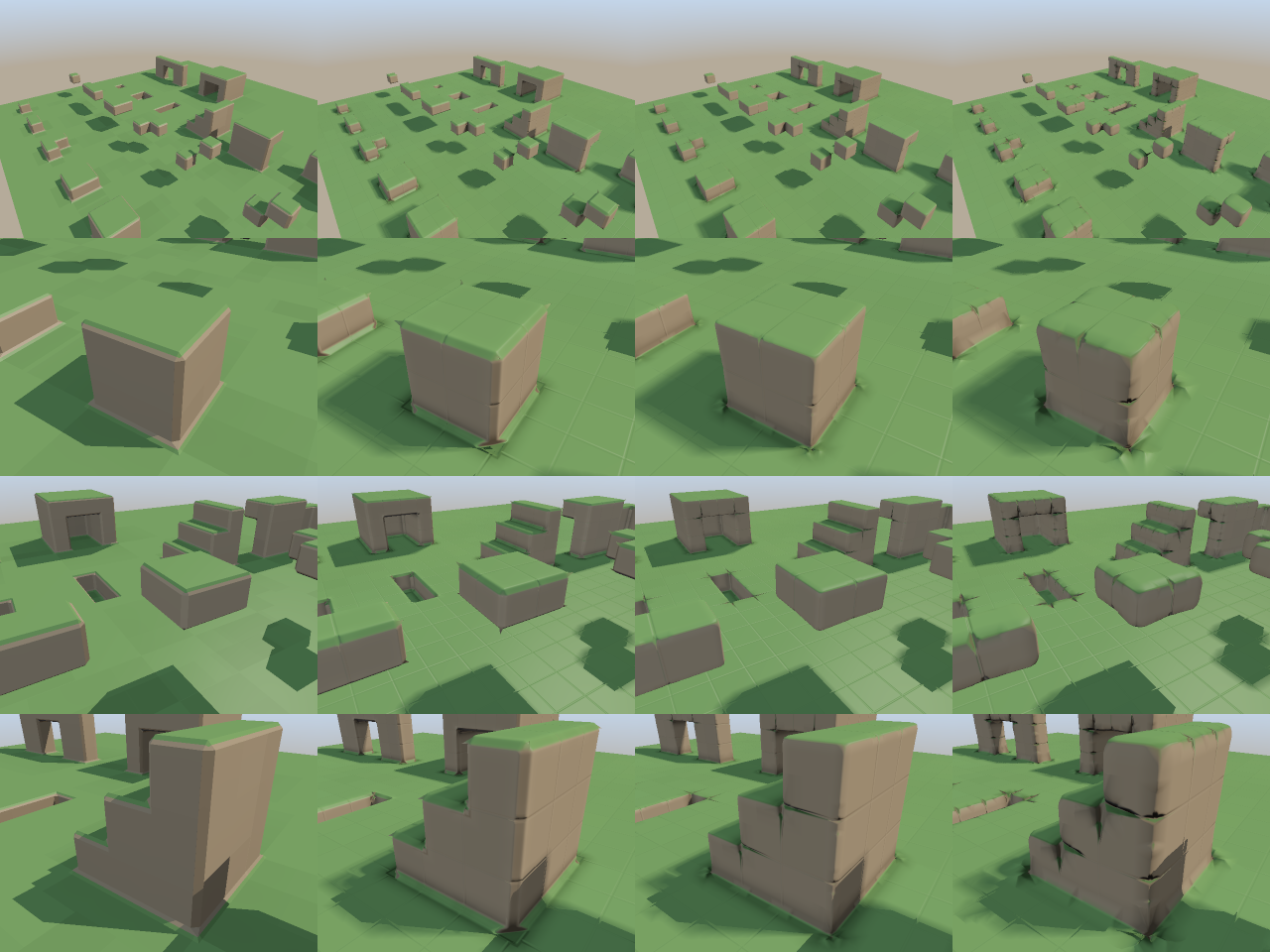
would come for free. The experiment ran all the way to the seamless sheet
above -- flats exactly flat, both knobs live -- and still argued against
itself, because the promise turned out to be false. A star-local field is
only defined from the eight cells around the nearest lattice vertex, so it
is only trustworthy within about half a cell of the surface, and every
authored term reaches farther than that unless it is individually fenced.
Coherence was not structural; it was re-proven per term, which is the same
discipline the mesh rules already impose -- except that a mesh tears
loudly where a field paints its seams as quiet shading cracks, and the
sky-through-the-floor test of #RUAWR5 has no analogue that catches them. Two other codomains fell out along the way. Realizing the chamfer's own
geometry as a field reproduces #RUAWR5 at great cost and adds nothing.
The genuinely field-native codomain -- every solid cell a rounded box,
smooth-unioned, so a lone cell is a sphere at radius one half and
diagonal contacts grow bridges -- is a real look, but it cannot keep a
flat continuation flat: coplanar cells always meet in a quilted seam,
because per-primitive unions have no way to know two faces are one plane.
Knowing that is exactly what the star classification is, and once it is
back, the field is re-deriving #RUAWR5 with worse tools. The verdict: the tent field of #TI9NJP remains the right field answer for
a world that keeps its flats -- coherent by construction, eight cheap
reads -- and the site rules remain the right authored answer. The
classified-field implementation lives in the withdrawn commit
8e8cc65 and stays
withdrawn. The rounded-cell variant is the one part that did exactly
what it defined, and it came back as a style of its own: #2TQEBB. Mentioned in: Clay: the golf ball, a field that is its own definition The evidence is the list of what the field needed before it stopped
painting vertex-cube boundaries on the surface: Each fence is small and each was found honestly; the trouble is that the
list is open-ended, mixed corners were still puckering when the experiment
stopped, and closing them would have meant the full canonical case table
the codomain was supposed to dissolve. Method note for the next field
experiment: a plain-Lisp replica of the shader algebra, probed with plane
scans and zero-set root scans around one exhibit of #UTRJ2T, located every
one of these failures in seconds, where staring at renders had only
produced theories. The one survivor of #A7BV7E, kept as the What the object truly looks like: coplanar cells meet in a quilted seam
-- the golf ball -- because per-cell primitives cannot know two faces are
one plane; convex arrises round at the radius; coves fillet by the blend;
and diagonally touching cells, which every mesh rule of #6TEFOS must keep
separated, grow a bridge, because a smooth union cannot do otherwise.
At a radius of one half a lone cell is exactly a sphere and a bar a
string of pearls. The mesh is the two-ring grid of #RUAWR5's family with every point walked
onto the zero set by two Newton steps, tetrahedral gradients, the step
clamped by length and by a multiple of the distance value so a medial-axis
point cannot fling a vertex. The shading is what true distance buys and
the tent field of #TI9NJP cannot honestly offer: the sun shadow is sphere
traced with a penumbra set by the narrowest miss along the ray -- a
contact shadow that hugs the quilting -- and ambient occlusion is read
off four distance taps along the normal. The stocks of #ADEAKZ come along by the same definition rather than by a
trick: a smooth union carries its own partition of unity, each cell's
share being the softmin weight of its rounded-box distance over the melt
reach, and the surface colour is the weight-averaged stock albedo. A
timber deck melting into a granite rampart blends its colour exactly
where the geometry blends, and nowhere else. Clay also mixes with the other styles by stock rather than by scene:
Mentioned in: The distance codomain was tried, and argued against itself Referenced from code: Reproducible The canvas loop owns another thread, so configure its global
renderer state before it starts rather than dynamically binding
these specials around A shaping rule is judged at its sites, and a demonstration world with
thousands of them shows none well. The refounded atelier therefore keeps two
complementary fixtures. luft.render:make-gallery-solid isolates the
small occupancy stars on separate plots; luft.render:make-miter-study-scene
composes the mixed stars into the wall-side stepped mountain of #Z5NDTA. Both
run through the ordinary luft.render:start-viewer and
luft.render:capture-viewer-frame paths. Named Mentioned in: Rounding is the half-level set of the smoothed occupancy, Every term needed a fence, and the fences were the finding Intent. Make McCLIM the application model of the new atelier, not a widget
kit added after a renderer has already invented commands, focus, and
lifecycle. LUFT should be able to grow into the next game one feature at a
time without growing a second application beside it. Evidence. luft.render:viewer is now both the canvas event handler
and a The system boundary says which direction dependency flows. Done when. Done: the viewer is an application frame, its bindings are
ordinary CLIM commands covered by executable tests, the renderer loads without
the atelier, and the existing luvcraft command layer uses the same event
bridge. Mentioned in: Grow the workbench and the game as one command vocabulary Intent. Make the first workbench pane answer the question the picture raises:
which packed LUFT site is under the pointer, and how did its local shape rule
turn that site into the geometry being seen? Evidence. luft.render:raycast-site walks the retained solid chain and
returns one sparse luft.render:site-inspection at the semantic UI
boundary: oriented face site, solid cell, hit point and distance, stock, and
shape word. The viewer presents those values through a McCLIM application
pane mirrored into the existing canvas, so no second window or input owner is
introduced. Each dense face record also carries a 21-bit construction mask:
the internal U, V, and chosen diagonal edges whose two realized facet normals
actually differ. The fragment shader uses screen derivatives only to keep
those approved edges crisp. Done when. Done: Escape releases the pointer, moving it ray-casts the world,
the inspector follows semantic site crossings, Mentioned in: The same field read as a drawing Intent. Add atelier tools, authored-world interaction, and eventually game
features as panes, presentations, commands, and command-table layers of this
one frame. A feature crosses from luvcraft when LUFT owns its semantic command
and state transition; the old implementation remains an oracle until then and
is deleted after the crossing. Rendering continues to consume immutable
scene/view snapshots rather than acquiring input or UI policy. Evidence. #OK62XM establishes the frame, owner thread, shared gesture bridge,
and renderer/application split. #7OH71A now supplies the shared default status
line, M-x, metabar, lobby radio and panel, capture, Tracy, live-artifact,
lifecycle, and agent boundaries; LUFT contributes commands, settings, fields,
and instrument attachment through thin methods. The command-vocabulary
surface therefore exists, while parameter prompting remains #OL2JZ1. Done when. One editing tool uses presentations and a modal command layer,
and the first luvcraft gameplay feature has crossed with its former application
path removed rather than maintained in parallel. Mentioned in: The workbench belongs to the Lisp application, Extract the application workbench beneath both games Intent. Make a voxel edit the sparse chain delta it is, rather than a request
to mesh the world again. If the solid is C, its surface is S=\partial C,
and an edit is the signed 3-chain \Delta, the complete update is Evidence. luft.render:apply-scene-edit now performs exactly that
addition after validating the whole edit against binary occupancy. The
surface is also a direct sum of 8³ chunk ledgers. A chunk has at most
3\cdot8^3=1536 face geometries -- one 8³ set for each face extent -- so it
owns one stable, exactly bounded GPU page. Only summands met by
\partial\Delta are reordered; their page offsets never move. Occupancy is
updated one 32-bit word at a time, and a bounded revision history lets several
renderers catch up incrementally or fall back honestly to a full cohort. The viewer's grid ray now removes its hit cell with left click and places into
the preceding empty cell with right click. Differential tests cross chunk
boundaries and the horizontal torus through additions, removals, and eighty
successive toggles; after every group the incremental surface, packed pages,
dense occupancy, and fresh luft:surface-chain agree. A Vulkan test
observes one ordinary edit as two writes -- one face page and one occupancy
word -- smaller than the full scene upload. luft.render:film-atelier-construction turns the proof into three
films: the Holm rises, winds into place, or is subtracted from a sacrificial
granite prism. The 49,294-cell spiral uploaded 4,484,904 bytes across all of
its incremental publications; one full reserved scene cohort was 3,801,088
bytes by itself. Done when. Done: edits no longer call luft.render:refresh-scene, the
reference and GPU tests pass, clicks use the incremental path, and all three
construction orders finish at the exact authored solid and boundary. Intent. If vertex invocations over absent or back-facing sites become a
measured bottleneck, compact visible face indices before drawing. Compute
compaction plus an indirect draw and a future mesh/subgroup path are competing
experiments; this mark does not pre-authorize a second permanent terrain mode. Evidence. The current world draws thousands of faces at trivial cost. The
mesh experiment of #VAABY9 duplicated substantial renderer and shader truth
without becoming the reliable default, so it was removed. A new path needs a
profile and a deletion story before it needs subgroup vocabulary. Done when. A representative larger scene shows face reconstruction as a
bottleneck, one compaction experiment improves measured frame cost on a real
backend, and its surface input remains the encoding of #AGVXGM. Intent. A camera outside the fundamental domain sees a cut world: faces at
Evidence. The first render, taken from Done when. Flying across the seam of a small domain shows the world repeat
without a gap.A site is a lattice anchor, an extent mask, and a polarity #KE4P5F
XYZ and one polarity
bit in the low positions, then a 24-bit X anchor, a 24-bit Y anchor, and an
8-bit Z anchor. Each extent bit says the site spans the unit interval forward
from its anchor along that axis, so no extent is a vertex, one is an edge, two
a face, and three a cell. The clear polarity bit is positive and the set bit
negative; luft:opposite-site toggles it without changing the site's
geometry.(x,y,z) has the
same geometry as the low X boundary of the cell at (x+1,y,z), but the two
faces have opposite polarities. X and Y wrap with the period a
luft:world-domain chooses; Z is 256 non-wrapping planes.i-th present axis has the canonical polarity (-1)^i,
the low boundary has the opposite polarity, and a negative input site reverses
every result. Thus luft:map-site-boundary returns signed sites
directly, and ∂∂ = 0 is an executable annihilation test in
luft/tests.lisp.A block world is a 3-chain and its surface is a boundary #9HLYEE
∂(∂ solid) = 0 says the surface is closed. Editing a cell later
means adding its signed boundary or the opposite boundary, not remeshing
anything.The GPU reads signed sites directly #AGVXGM
(unsigned-byte 64) buffer the shader reads; no vertex is ever built on the
CPU. The renderer orders the sites by eight-cell chunk, pads them to whole
chunks for locality, keeps one absent word for an empty surface, and binds the
specialized vector as one storage buffer. Dense occupancy bits and packed
stock slots let shaders ask about the cells around each site without turning
those cells into vertices first.Storage buffers and bit fields enter the shader language #HFX2LI
:storage-buffer resource with an :element type, indexed by
buffer-element; the array has no declared length, and a bare reference to
the buffer is an error. Metal lowers it to const device T* name
[[buffer(n)]] bound through the same argument-table address slot as a
uniform buffer, and SPIR-V to a StorageBuffer block holding one
RuntimeArray with an explicit stride, asking for
SPV_KHR_storage_buffer_storage_class in 1.0 modules.ldb with a literal (byte size position) on a :uint or :uint64
value, so a shader unpacks a site with the very words luft.lisp uses.
Metal lowers it to a shift and a mask in the operand's width; SPIR-V to
two logical shifts, because Vulkan restricts bit-field instructions to
32-bit operands and the language has no 64-bit constants.:storage buffer usage,
:storage-buffer binding type, and typed write-buffer for unsigned arrays.
Those facilities now serve both backends and outlived the mesh experiment that
first forced them.defclass shader-storage-buffer language.lisp:263 ↗
buffer-element
and the host decides how many elements it uploads. #HFX2LIThe mesh-shader experiment found a budget, then ended #VAABY9
VK_EXT_mesh_shader's guaranteed minima of 256 for each. The earlier
seven-face group declared only 252 vertices but 350 primitives; RADV accepted
the pipeline and then reset the GPU on first submission. That failure remains
useful evidence: every output budget matters even when pipeline creation does
not reject an excess.luft/render: a scene holds the solid chain and its
products, a renderer holds the GPU objects, luft.render:render-to-png
draws headlessly, and luft.render:start-viewer opens a window with a
fly camera. Its test turns the camera straight up and expects only sky,
which is the frustum test doing real work.LUFT_RENDER_MODE=clear submits a clear and copy with no shader pipeline;
sky adds only the background; each style name creates only its own surface
pipeline; full restores every style plus sky and lens, and on Vulkan the TAA
graph of #DOEDL3. Thus a driver failure can be localized by increasing one
semantic layer at a time rather than constructing the entire atelier before
the first frame.Vertex shaders are the one terrain path #NV25VM
(unsigned-byte 64) buffer, takes the remainder to
learn which corner of which triangle it is, and unpacks anchor, extent, and
polarity with the same ldb forms as #AGVXGM. A flat face
is six vertices, the two triangles (0\,1\,2)(0\,2\,3) around the anchor
corner, reversed when the polarity is negative so the loop stays
counter-clockwise from outside. An absent site or a back-facing face
collapses every one of its vertices onto the anchor, and the rasterizer drops
the degenerate triangle. With twelve thousand faces in the demonstration
world, clipping is cheap enough that the renderer simply draws everything.luft/render/vertex-shaders.lisp. Temporal jitter changes only their last
clip-space step; their world positions remain the stable inputs to motion
(#C7WIN4).Fillets and bevels belong to edge and vertex sites #6TEFOS
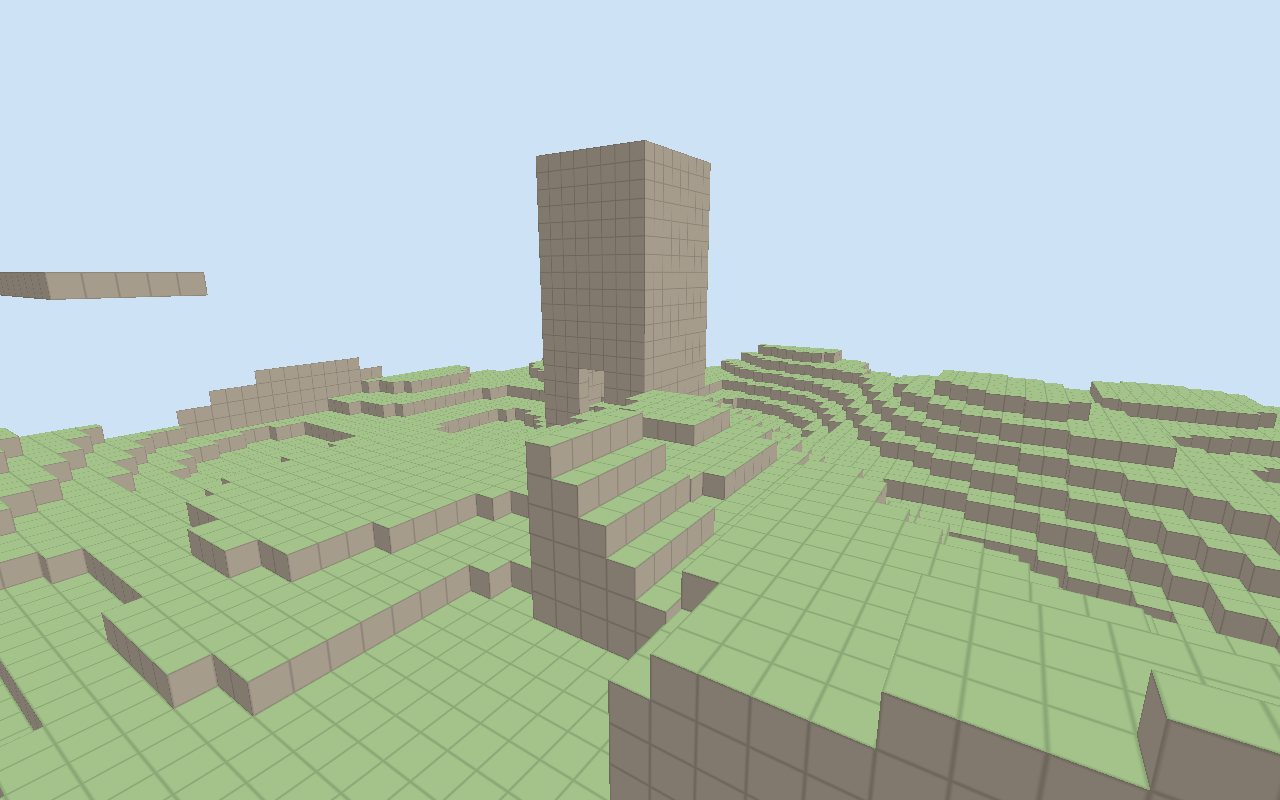
luft/render/shaders.lisp subdivides each face 6×6:
boundary points use the site rule, ring points inside the radius project onto
the nearest crease's cylinder or the corner's sphere (a pure one-cell corner
is the exact rounded box), and mixed corners such as a block standing on a
floor blend toward the vertex sphere by distance. The only CPU help is
luft:chain-cell-bits, the solid chain as one bit per cell, from
which each shaped vertex gathers the cells in its nearest corner's star; the
rounding radius is a live frame lane. The exact morphological answer for the
mixed stars would be a table over the 256 vertex configurations, which this
heuristic postpones.Small planar facets soften convex and concave creases #RUAWR5
The miter family portrait keeps the awkward stars in context #Z5NDTA

luv/showcase recipe rather than checked-in evidence:scripts/captures render --output build/wiki/media luft-miter-studydefine-capture luft-miter-study luft-portraits.lisp:7 ↗
start-viewer.defun make-miter-study-scene render.lisp:469 ↗
Rounding is the half-level set of the smoothed occupancy #TI9NJP
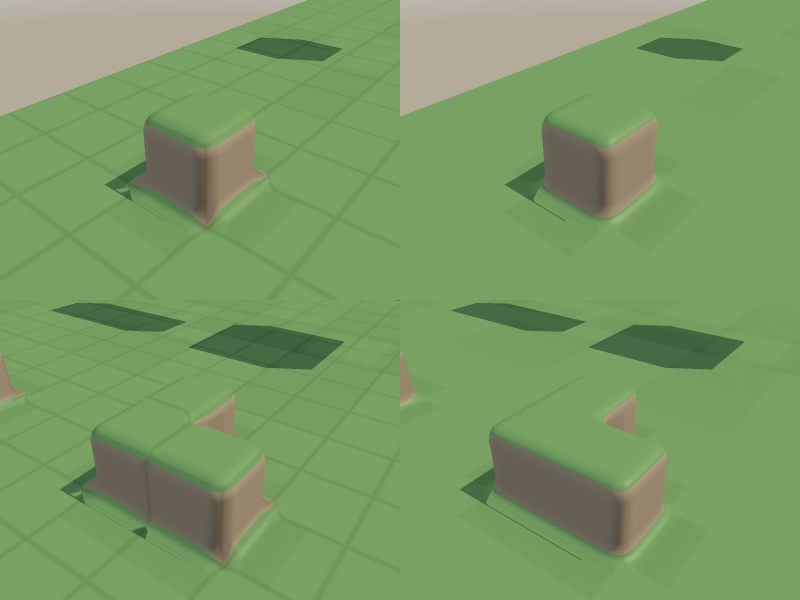
:field style replaces the classification
with a definition (right column).luft/render/field.lisp).:soft style draws the six-vertex
flat quads under this very fragment shader and rounds by light alone, at a
distance indistinguishable from the projected grid. The fragment reads the
field once more under a half-cell tent to learn whether it sits in a hollow
or on a ridge: *wear-strength* lightens ridges and darkens cavities by
that measure, the wear of a handled thing. Its shadow is the field's too:
where every other style walks the sun ray cell by cell and answers yes or
no, so that shadow outlines are staircases of cells, the field style samples
the half-cell tent along the ray and keeps the greatest occupancy met, and
the outline softens over about a cell like the shadow of an area light
(luft.render.shaders::field-shadow). The turf and earth tones
meet across the fillet by the smooth normal's upness rather than along a
line through its middle. The tent may be wider along Z than across
(*field-vertical-radius*), rounding the edges of floors and roofs more
than those of walls as weather does, though at extreme ratios the three
Newton steps leave visible wobbles. The watertightness test of #RUAWR5
passes for the field as for every other style.The same field read as a drawing #JM9807
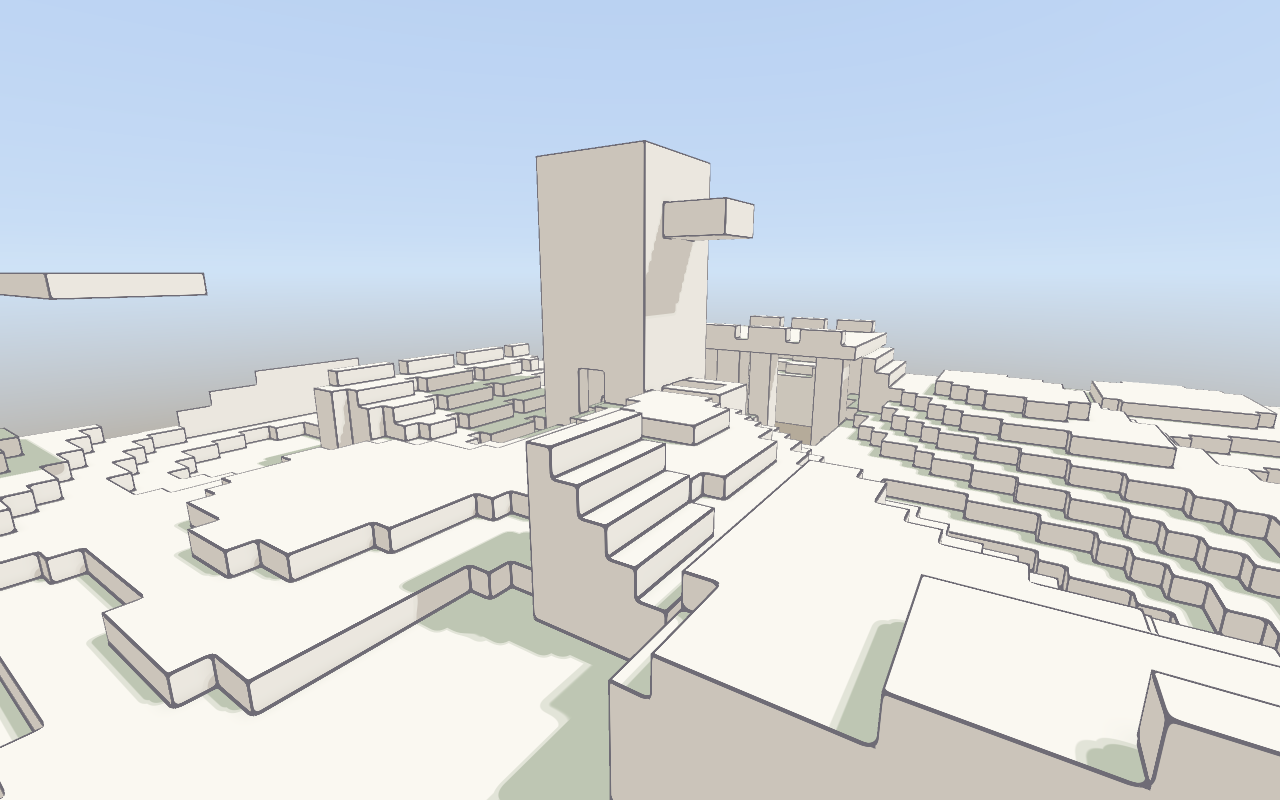
:ink style draws the flat
six-vertex quads and inks every crease, convex edges and concave coves
alike, as a pen would; bands the key light into a few flat tones; keeps the
field's soft shadow as a wash; and fades into the paper with distance
instead of fogging. A pen keeps its width on the page, so the band is
*ink-width* pixels wide, measured by how fast the tilt changes across the
screen (the fragment's derivatives), and never wider than the crease itself.
The field's occlusion is the same idea turned along the normal: a few
samples of the half-cell tent out from the point, nearer ones weighted more,
replace the four cell walks of crowded-sky with a measure that is smooth
because the field is (luft.render.shaders::field-occlusion).A world knows what it is cut from #ADEAKZ

:stock style
draws the chamfered geometry of #RUAWR5, which is what these materials are
for, and lights it from the occupancy field of #TI9NJP: a soft shadow and a
smooth crowding, so the edges stay crisp while the light stays gentle.How a cell says which stock it is #PWMCOL
*stock* and
fills, the way a shop works from one board at a time:An hour is a set of the light knobs #KG0EG6

*light* says
which is in force. :morning is low and cool from the east, :noon is
nearly overhead and kills the shadows, :evening is very warm with the
shadows gone blue, :overcast has no sun to speak of and lets occlusion do
all the drawing, and :afternoon names nothing at all, so it is exactly the
atelier's own light and every knob still works by hand.An architecture of arches, discs, and corbels #SY26PO

luft/render/architecture.lisp, and each becomes architecture once the
chamfer runs along its staircase and the stock says what it is cut from.
define-capture luft-miter-study luft-portraits.lisp:7 ↗
luft plates and short upright cuts. Still images own the exact
scene and camera being studied; films keep motion and cleanup in luft's
existing film owners. #Z5NDTA #SY26PO #2TQEBBstart-viewer.Turf catches where the ground is flat #JNJF28

Five pieces and a sheet of stocks #6QZYNB

:samples, every
stock as one small object; :joinery, one object of several stocks, so the
creases between them can be looked at; :arcade, a wall of round-headed
openings on a stylobate under a corbelled cornice; :turret, a machicolated
round tower with a curtain wall and a bailey; :viaduct, piers in a box
canyon carrying a road; :grotto, a hall cut into a cliff behind an arched
mouth; :headland, which has no building on it at all and is the landscape
the others are supposed to stand in; and :holm, which is the argument that
they compose.
The lattice need not be square #REZ0PU

*deformation* is one more special for
a contact-sheet column to bind.A lattice that wanders, modulated by what the cells are made of #86IMVU

floor is a coin
toss, and the faces along a crease belong to different cells.
(with-stock (:limestone) (ring-arch ...)) and the rest follows from two
numbers on the material.A chamfer belongs to the crease, not to either face #K5MKUT

:relief asks the star its shape. An outward arris is planed wide and an
inward cove left nearly sharp, which is what weather and hands actually do
to a building, and which also disposes of a long-standing artifact: the
pale wedge where three coves meet at a re-entrant corner simply stops
existing once the coves are narrow.:stock takes the least chamfer any solid cell of the star asks for. A
crease between a planed timber and a pecked stone comes out as sharp as the
stone -- the sharper stock wins, which is what a mason does with a stone
that will not take an arris. A minimum over the star is symmetric in it,
so every incident face computes the same width from the same cells,
whichever of them it happens to be.What the watertightness test caught #HJ6YTC
*chamfer-width* became the band the grid reserves and no rule may exceed
it, and each site takes up to all of it. The facet is then not exactly
forty-five degrees where a site takes less than the whole band, which is a
price worth paying for a surface that is closed.The distance codomain was tried, and argued against itself #A7BV7E
Every term needed a fence, and the fences were the finding #4PX7PL
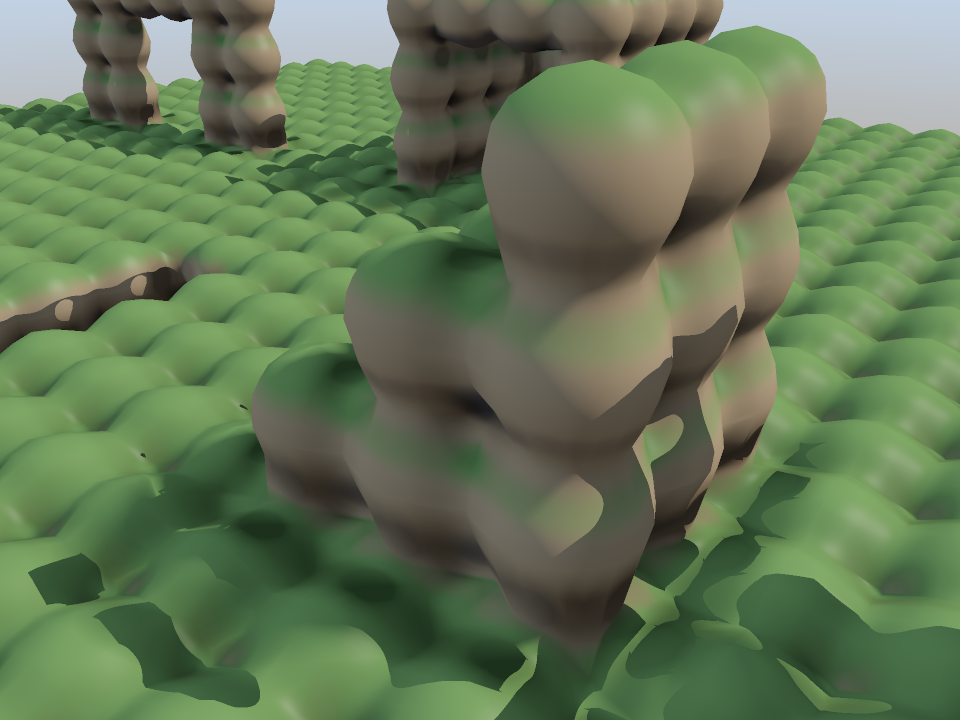
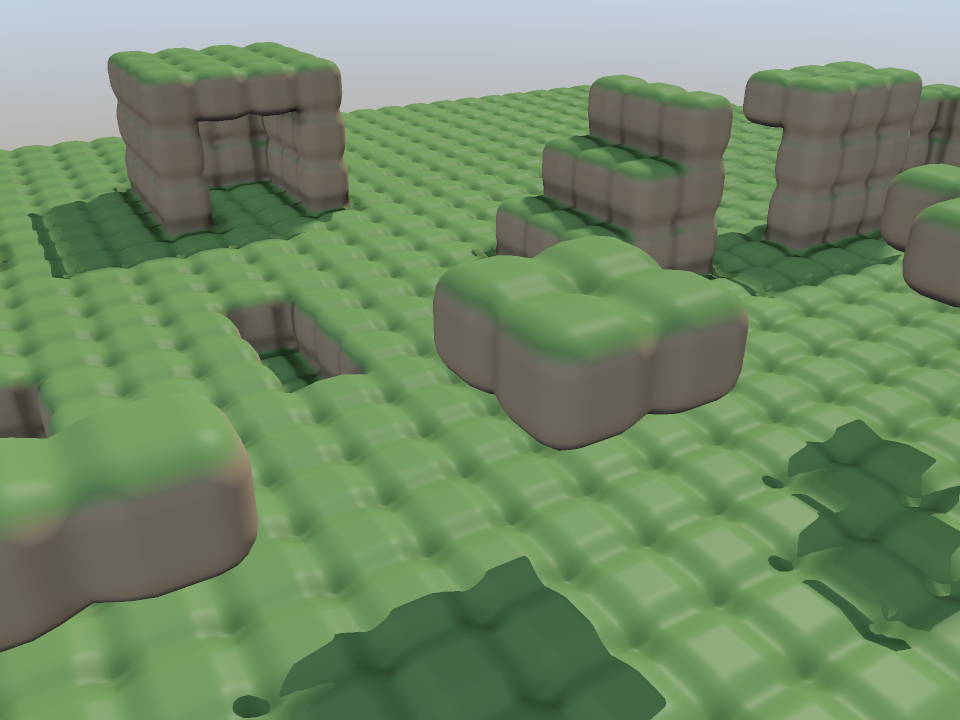
Clay: the golf ball, a field that is its own definition #2TQEBB
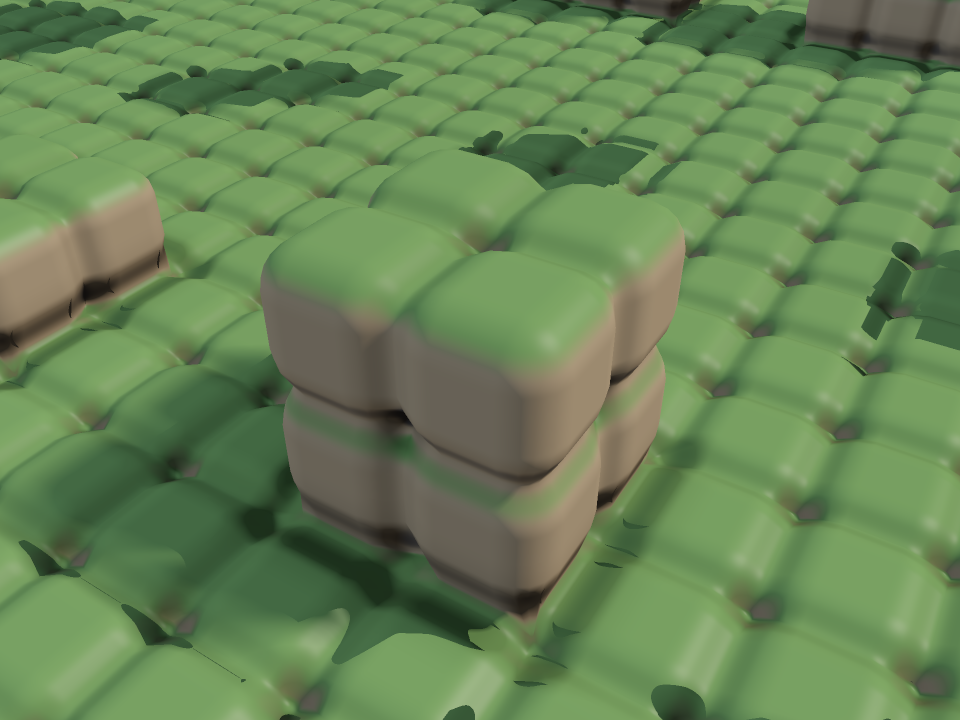
:clay style
(luft/render/clay.lisp), because it
meets the standard the classified field failed: the field is its
definition. Every solid cell is a rounded box -- the cell's box shrunk by
the radius, its distance lowered by the radius -- and the world is their
smooth union at one melt reach. The surface is that field's zero set,
exactly; there is no target it approximates, no fence tuned against a
picture, and nothing in it with a reach that needs policing. A solid cell
outside the star of the nearest lattice vertex stands at least half a cell
from that vertex's cube, so with the melt at most one half the eight-cell
reading agrees with the global union everywhere near the surface.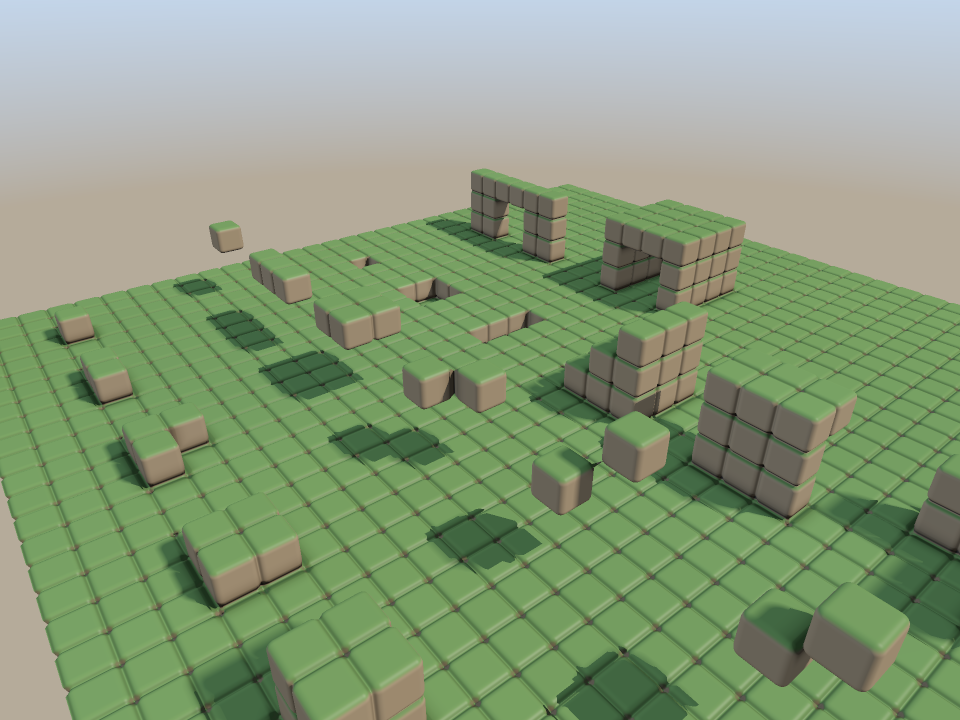
*clay-radius* and
*clay-melt* ride in the frame block, so a film can breathe them
continuously; such a film runs without temporal accumulation rather than
pretending its history is reusable.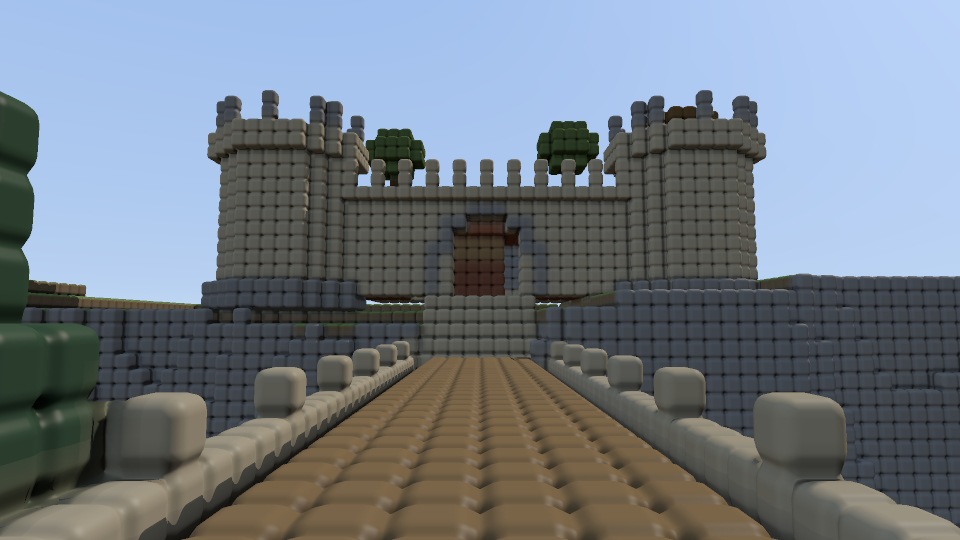
*clay-stocks* names materials the clay overlay owns, their packed
slots ride a spare frame lane, each vertex stage collapses the faces the
lane claims -- the clay rule draws exactly those -- and the clay field
treats every unclaimed cell as air. A world of chamfered masonry whose
conifer and leaf crowns are full-radius clay blobs is then one extra
draw, and the clay knobs ride two more spare lanes so the chamfer keeps
its own width beside them.define-capture luft-miter-study luft-portraits.lisp:7 ↗
luft plates and short upright cuts. Still images own the exact
scene and camera being studied; films keep motion and cleanup in luft's
existing film owners. #Z5NDTA #SY26PO #2TQEBBstart-viewer.The studio: a world of stars under the same cameras #UTRJ2T
luv/showcase recipes
own cameras and output sizes when a picture becomes durable evidence, while
the live atelier remains free to orbit, point at, and reload the same scene.DONE The atelier itself is a McCLIM application #OK62XM
standard-application-frame. It deliberately has no frame process and
no second native window: portable canvas events resolve through layered CLIM
command tables and execute inline on the canvas owner. Movement press and
release, reset, pointer escape, fullscreen, and Control-Q are named commands.
Native close, Control-Q, standalone cleanup, and interactive
luft.render:stop-viewer converge on one idempotent teardown with a
frame-boundary barrier before renderer resources disappear.luft/renderer
owns packed-site shaders, materializations, and GPU resources;
luft/render adds the McCLIM atelier. The portable key-event/gesture bridge
lives in luv/mcclim and luvcraft imports it, so LUFT did not copy the old
game's application glue in order to inherit its behaviour.DONE Pointing reveals a site's topology #UWRDQI
C toggles the resulting global construction
drawing; a cyan reticle marks the ray intersection and reveals the complete
local triangle lattice without an area fill or distance halo. Face rims remain
lighter evidence of the cubical complex that owns those triangles.C globally toggles stable
construction lines, and a ray hit is a crisp blueprint reticle rather than a
dark smudge.NEXT Grow the workbench and the game as one command vocabulary #WO50UR
DONE Cell edits are linear boundary updates #3QNZC1
IDEA Compact surviving faces only when measurement earns another path #WQ611A
IDEA Draw the torus, not only its fundamental domain #PGRM80
x=0 that a solid neighbour at x=period-1 cancels are honestly absent.
The vertex stage could translate each site's anchor by the domain period
toward the camera, or the host could draw the nearest translated instances,
so the wrap becomes visible instead of surprising.x-6=, showed exactly this cut.
One descriptor-backed read-only array of uniformly typed elements. The array has no declared length: a shader indexes it with BUFFER-ELEMENT and the host decides how many elements it uploads. #HFX2LI
A descriptor resource and, for textures, the represented meaning and colour transfer of the value returned by sampling.
Read one indexed element of a storage buffer resource.
(name (&key figure kind extension (description "") (layout :landscape))
(pathname) &body body)Define one inspectable wiki capture recipe. NAME is its command-line identity. FIGURE is the stable six-character wiki figure ID; KIND is :IMAGE or :VIDEO; EXTENSION is the generated file suffix. LAYOUT is :LANDSCAPE by default or :PORTRAIT for uncropped 9:16 presentation. BODY is an ordinary named renderer function…
Either :PERSPECTIVE or :ISOMETRIC. An isometric picture has no vanishing point, so two chamfers the same width are the same width on screen wherever they sit. That is what makes it the projection to judge a shape rule in.
How many world units of height an isometric frame spans.
Global construction-edge strength. The atelier toggles it between 0 and 1.
Whether a ray hit gets a blueprint reticle and local triangle-edge lens.
(&key
                       (solid (make-mountain-sanctuary-scene))
                       (bevel-width 2)
                       bevel-profile
                       surface-mesh
                       (camera (make-fly-camera))
                       (title "LUFT — click to walk · scroll to zoom · M orbit")
                       (width 1100) (height 800)
                       fullscreen-p
                       (inspector-p nil)
                       (frames-per-second 60)
(provider *gpu-provider*))Open the indexed-instanced LUFT renderer as a McCLIM atelier. BEVEL-PROFILE enables the experimental material-selected width cohorts for a non-streaming scene. BEVEL-WIDTH remains the camera/inspection reference and the uniform fallback. SURFACE-MESH supplies an already constructed diagnostic mesh while retaining…
()Build the wall-side stepped mountain used to judge mixed miters. #Z5NDTA The two L-shaped terraces retain five-, six-, and seven-cell vertex stars in one architectural context. Their back edges meet a continuous wall so the same view also retains the truncated wall miter preserved by #DJK8HW.
Default bevel width in eighth-cell integer ticks (one quarter cell).
(&key (position
            (vec3:make-vec3 (+ 70.0 +sanctuary-origin-x+)
                            (+ -18.0 +sanctuary-origin-y+) 50.0))
          (yaw 2.2455373) (pitch -0.5165006)
(field-of-view 0.9599311))(x y z)(pathname &optional (viewer *viewer*)
&key (inspector-p (viewer-inspector-p viewer)))Render one native-resolution VIEWER frame offscreen into PATHNAME. INSPECTOR-P defaults to VIEWER's inspector setting. A source-defined evidence capture may override it when the subject is the geometry rather than the atelier UI.
(&optional (viewer *viewer*))Stop VIEWER exactly once and publish one result to every caller. Native canvas-thread handlers use REQUEST-VIEWER-QUIT instead: a synchronous owner or waiter is rejected there because teardown crosses a frame boundary.
(&key (horizontal-bits 6) (origin-x 0) (origin-y 0))(builder x0 x1 y0 y1 z0 z1
&key (solid-p t) architecture-p
(material (if architecture-p *sanctuary-material-placement*
*terrain-material-placement*)))(builder x y z &key (solid-p t) architecture-p (material nil material-p))(builder &key player-p)A site is a 60-bit unsigned value: three extent bits XYZ and one polarity bit in the low positions, then a 24-bit X anchor, a 24-bit Y anchor, and an 8-bit Z anchor. Each extent bit says the site spans the unit interval forward from its anchor along that axis, so no extent is a vertex, one is an edge, two a face, and…
A LUFT site occupies sixty bits and travels to the GPU in sixty-four, so four bits are free above it (#KE4P5F). The packed site spends them on which stock the solid behind the face is cut from: sixteen materials in a world, at no cost in bandwidth and none in a second lookup. A luft.render:world is a chain together…
Luv has two shader languages with deliberately different jobs. The literal language in hal/vulkan/spir-v/instructions.lisp names every result id and every SPIR-V instruction. It is a good machine form, an assembler input, and a debugging view. It is a bad place to state that illumination is ambient light plus a sun…
A surface face is already one signed 60-bit site, with no separate wrapper or coefficient encoding. It remains an immediate fixnum on 64-bit SBCL, and a specialized vector of sites can be copied directly into the (unsigned-byte 64) buffer the shader reads; no vertex is ever built on the CPU. The renderer orders the…
One rasterized frame samples each pixel once. Luft moves that sample to a different subpixel on each frame with an eight-sample Halton(2,3) sequence, then reprojects the last resolved picture so samples from different frames describe the same world points. A static camera therefore gathers eight positions within a…
The refounded indexed chamfer is the planar case of #6TEFOS. Every canonical edge or vertex site reads its complete occupancy star, chooses the strict minority, and reduces that minority's moment to a signed direction q. Convex creases therefore move toward minority solid cells, concave creases toward minority air…
Rounding a crease is not something either face beside it can decide alone, and in LUFT it does not have to be: the crease is an edge site, its four surrounding cells are its star, and a vertex site has eight. The star's solidity classifies the crease — flat, convex, concave, or saddle — and one rule places the shared…
Let q_t be the unjittered UV position of a world point under the current view, q_{t-1} its position under the previous view, and j_t the current clip-space jitter. The motion attachment stores without jitter. The current raster sample lies at u=q_t+j_t/2, so resolve addresses history at Keeping the two terms…
Intent. Understand whether an Arc-like mixed miter can preserve LUFT's site-local ownership, CPU-authored discrete geometry, bounded records, and fixed dense rendering without complicating every ordinary sharp bevel. Evidence. Closed by the offset construction recorded in The beveled surface is a sum over sites. What…
A shaping rule is judged at its sites, and a demonstration world with thousands of them shows none well. The refounded atelier therefore keeps two complementary fixtures. luft.render:make-gallery-solid isolates the small occupancy stars on separate plots; luft.render:make-miter-study-scene composes the mixed stars…
images/luft-field-corners.png The star rules of #6TEFOS place each shared point by classifying its eight cells, and the studio of #UTRJ2T shows where that runs out: a block standing on a floor, a bar's foot, any mixed corner where a convex crease meets two concave ones. There the vertical fillet flares into a skirt…
Intent. Make the first workbench pane answer the question the picture raises: which packed LUFT site is under the pointer, and how did its local shape rule turn that site into the geometry being seen? Evidence. luft.render:raycast-site walks the retained solid chain and returns one sparse luft.render:site-inspection…
images/luft-hours.png Setting eleven specials by hand is not how anyone chooses a time of day, so a luft.render:light names a set of them together and *light* says which is in force. :morning is low and cool from the east, :noon is nearly overhead and kills the shadows, :evening is very warm with the shadows gone…
images/luft-viaduct.png luft.render:atelier-scene and luft.render:atelier-cameras are generic functions on a piece's name, so a sheet can ask for all of them without knowing any of them and a new piece is one method and one entry in luft.render:atelier-pieces. There are eight: :samples, every stock as one small…
Both rules were wrong the first time, and the sky-through-the-floor test of #RUAWR5 said so before any picture did. First: classifying a crease by the sign of the minority's dot with the face's outward normal is right at an edge, where that dot is exactly \pm 1 and the star determines which, and wrong at a mixed…
images/luft-arris.png The chamfer width of #RUAWR5 was one number for the whole world and need not be. But it cannot be a property of a face: two faces meet along a crease, and if they disagree about how far to move the point they share, the surface tears. It has to belong to the site, which means it has to be a…
images/luft-clay-sheet.png The reconstruction-alphabet note (idea-for-reconstruction-alphabet.org) asks what the star alphabet of #6TEFOS could grow into. One candidate was a signed distance field: keep the same edge and vertex stars, counted exactly as #HJ6YTC counts them, and let an alphabet entry be a…
images/luft-stocks.png Every style up to here shaded the world in one substance -- turf above, earth at a cut, dark underneath -- because a face's direction was the only thing a fragment knew about the matter behind it. That is enough to read a solid and not enough to read a building. A stone pier and an oak…
Intent. Make McCLIM the application model of the new atelier, not a widget kit added after a renderer has already invented commands, focus, and lifecycle. LUFT should be able to grow into the next game one feature at a time without growing a second application beside it. Evidence. luft.render:viewer is now both the…
Intent. Give general Lisp-application tools one reusable owner, with thin Luvcraft and LUFT adapters, so improving their reliability improves both experiments without making their gameplay models the same. Evidence. The current systems separate luv/mcclim, luv/lobby, luv/tracy-capture, and luv/application-agent from…
Intent. Finish what #0IF4TY promised: the command menu should offer commands with arguments, prompting through accept with the presentation types the agent already uses, so place-block-at is one definition reachable by key, M-x, and tool. Evidence. The tool side already reads the command parser table. The M-x gap is…
images/luft-atelier.png The first GPU path had task and mesh stages and no vertex buffer. A task workgroup owned a small brick, culled its bounding sphere, and handed the brick index through a payload. Mesh lanes loaded signed sites, unpacked anchor, extent, and polarity, and emitted their vertices and triangles. …
The mathematical shader language of #S4H8DR had textures, samplers, and a vec4-only uniform block, and no way to read an array of 64-bit words. Two additions carry a site into a shader: – A :storage-buffer resource with an :element type, indexed by buffer-element; the array has no declared length, and a bare…
Three user-supplied screenshots preserve the visual argument. The first is the original LUFT junction, deliberately zoomed and framed on the problem: the green chamfer strip loses its width and collapses into the one shared point. images/luft-miter-initial-collapse.jpg The second is the first attempted repair. Extra…
The shared-point rule of #RUAWR5 is compact and watertight, but it gives every incident chamfer strip only one place to end at a mixed vertex. At the wall-side step this truncates a strip which should continue around the meeting: the long miter collapses into a narrow triangular fighter shape. That is the coherent…
images/luft-arcade.png A cube world's reputation for making only boxes is a reputation for having no vocabulary. A round-headed opening is a column of cleared cells whose height follows a circle; a tower is a disc repeated up Z; a corbel is a course that oversails the one below. Each is a dozen lines…
images/luft-clay-pillow.png The one survivor of #A7BV7E, kept as the :clay style (luft/render/clay.lisp), because it meets the standard the classified field failed: the field is its definition. Every solid cell is a rounded box -- the cell's box shrunk by the radius, its distance lowered by the radius -- and the…
Reproducible
luftplates and short upright cuts. Still images own the exact scene and camera being studied; films keep motion and cleanup inluft's existing film owners. #Z5NDTA #SY26PO #2TQEBB