A terminal in the little world
A terminal is a world-native interactive surface #NMAD2U
The luv terminal should be an object in the little world, not a conventional terminal window captured into a texture. Its rectangular cell grid has a position, orientation, depth relationship, and input surface in the scene. Ghostty supplies terminal semantics; luv's Slug path supplies glyph outlines; the ordinary scene pass supplies projection, depth, composition, and eventual lighting policy.
This is a stronger version of the existing McCLIM gadget experiment. The gadget proves that a live interactive surface can share luvcraft's canvas and GPU device, occupy a perspective-projected quadrilateral, and receive pointer events translated back through that quadrilateral. It still paints a CPU raster mirror and samples the resulting texture. The terminal should retain the placement and event lesson while replacing the raster mirror with native cell, decoration, and Slug glyph draws.
The result is not merely sharper terminal text. A world-native renderer can reuse scene depth, animate or transform the surface without rerasterizing a bitmap, update only changed rows, and keep text as inspectable terminal cells until draw data is built. The shaped world-text proof #QW7P96 and its per-device outline cache #U5X6DY show that the necessary outline path already participates in a real frame.
Mentioned in: Four earlier harnesses, read for what luv can borrow, Nxt: a hung agent is a question you can ask the process, Nxt: a HUD pinned under scrolling output, drawn from typed diffs, A luv agent surface would inherit these seams, Restarts are a tool argument, What luv could take from Autolith, A shell scope is a session object with a screen and an observation, Compare Slug coverage at glyph edges
The McCLIM gadget leaves a useful interaction seam #0U22KN
open-luvcraft-widget-lab constructs an embedded McCLIM frame against the world session's existing canvas, context, and device. encode-luvcraft-overlay lets that object contribute draws to the open scene pass, while handle-luvcraft-overlay-event lets the frontmost overlay consume an input event. The gadget implementation also performs the perspective-correct inverse mapping from a canvas pointer coordinate to a coordinate on its world plane.
Those are semantic boundaries worth keeping open. A terminal surface can be another overlay implementation with its own placement, focus, input, and release methods. The terminal's rows, cells, glyph instances, and generated vertices should remain dense data inside that object rather than acquiring individual CLOS identity. One dispatch per overlay or frame is useful; one dispatch per terminal cell would put the extensibility boundary in the hot loop.
The first terminal need not inherit from a McCLIM mirror or frame. Reusing the world-overlay relationship is the architectural result; sharing the CPU raster machinery would preserve precisely the indirection this experiment is meant to remove.
The terminal took that advice and the McCLIM instruments built after it did not, which is now visible rather than theoretical: #AX9ZTA describes the raster path they share, and #I3G0S7 measures what it costs their type.
Mentioned in: Bridge styled Ghostty render-state rows into the block wall, A terminal is sharp at any distance because its glyphs are geometry
Modal focus is a player relationship #8JCMA5
Luvcraft owns one optional modal focus independently of its overlay list. A focused object receives canvas events while ordinary walking, looking, block editing, jumping, and material selection are suspended. Entering or leaving focus clears held player input and releases relative-pointer capture, so a movement key cannot remain stuck across the boundary.
Tab is the temporary world interaction verb. With no modal focus it chooses
the best overlay under the centre view: terminal displays recognize a ray hit
on any block in their authored rectangle, while McCLIM surfaces recognize the
crosshair inside their projected quadrilateral. A terminal-material ray hit
without an existing display activates that authored face, starts its Bash PTY,
and focuses the resulting display. Once focused, ordinary Tab belongs to
the terminal for shell completion; Shift-Tab leaves modal focus. Focus
captures the player's view, then eases the camera toward a pose supplied by
the focused object. A terminal supplies its complete authored rectangle: the
camera moves square to that plane at a distance which contains every corner
inside a six-percent picture margin. Screen overlays independently report
obscured edge insets, so the McCLIM hotbar is excluded from the usable viewport
without making terminal code depend on McCLIM. Leaving focus eases back to the
captured aim and the player's current eye position. Focus also narrows the
lens from 70 to 50 degrees and hides the world crosshair.
This is the same player-facing transition whether the object is a McCLIM surface, a Ghostty terminal, an open book, or a mounted boat. Those objects do not need a common UI superclass. They implement focus-entered, focus-left, focused-event, and optionally focus-camera-pose methods according to their own semantics; other protocols can separately govern rendering, simulation, camera attachment, viewport insets, or vehicle motion. Removing a focused overlay or stopping the session leaves focus before releasing its resources.
Evidence: the terminal projection test checks all four surface corners against the safe rectangle at a representative hotbar inset, then checks complete pose restoration. In the live 1920 by 1280 Metal game, focus entered both from the saved player view and from a deliberately close, low aim at the wall's left edge; both approaches converged to the same uncropped head-on composition with 114 pixels reserved for the hotbar.
There is deliberately no universal Escape binding in this layer. Escape and
Tab are both meaningful terminal input. The provisional shared world
interaction uses Tab only to enter and Shift-Tab to leave; a future named
gameplay action can replace those raw bindings while continuing to call
toggle-luvcraft-session-focus.
Mentioned in: Riding is a focus that moves, The phone is a wall terminal you can carry
Referenced from code: Enter modal interaction with This is the common session transition behind using a world terminal or book,
mounting a vehicle, and other interactions described by #8JCMA5. Read the capture back after the previous focus has returned it, so a
focus-to-focus move keeps mouse look owed to the player rather than
forgetting it halfway.defun focus-luvcraft-session app.lisp:734 ↗
focus, suspending ordinary player input.
Ghostty owns terminal semantics, not the surrounding application #OAFDXL
The luv/ghostty spike pins Ghostty revision
26df373ec83fb1cebb4fee0a8394144ae984a9b8 and creates, feeds, formats, and
releases a GhosttyTerminal. The next layer should continue to treat
libghostty-vt as a semantic engine rather than an application framework.
| Owner | State and responsibility |
|---|---|
| world terminal | placement, focus, lifecycle, and participation in luvcraft's overlay protocols |
| PTY owner | child process, master descriptor, readiness, writes, exit, and shutdown |
GhosttyTerminal | VT parser, primary and alternate screens, scrollback, modes, cursor, selection, and protocol effects |
GhosttyRenderState | renderer-owned visible snapshot, colors, cursor presentation, and dirty rows |
| Slug terminal renderer | device glyph cache, dense row geometry, decorations, pipelines, and draw encoding |
This split follows libghostty-vt's own C surface. Its terminal API accepts VT bytes and exposes effects, but does not create a PTY, event loop, or render thread. Its render-state API copies the visible state needed by a custom renderer. Ghostty labels the C API work in progress, so the Nix revision pin is also the binding's ABI boundary; updating it should be an intentional tested change.
PTY traffic has one serialized owner #K3KFGZ
libghostty-vt does not pull bytes from a process. Luv creates a PTY, starts a
child, reads the master descriptor when ready, and passes each byte slice to
ghostty_terminal_vt_write. Feeding bytes mutates the terminal immediately.
It does not emit a damage callback; the host merely requests a later render
update and lets the render state say whether anything visible changed.
flowchart LR
  P[PTY master readable] --> R[owner reads bytes]
  R --> V[Ghostty VT write]
  V --> E[synchronous effects]
  V --> F[request a frame]
  E --> Q[copy replies into PTY write queue]
  K[key, mouse, paste, focus] --> I[Ghostty input encoders]
  I --> Q
  Q --> P
  F --> S[update render state]
  S --> D[draw dirty rows with Slug]
Effects such as bell, title changes, clipboard requests, and terminal-generated
query responses are synchronous callbacks made inside the VT write. The
WRITE_PTY effect is therefore a route back to the PTY, not the incoming data
path. A callback must copy borrowed bytes and enqueue them quickly; it must not
recursively feed the same terminal or block the PTY reader.
Keyboard and mouse encoders read the terminal's current modes before producing
bytes for the PTY. Resizing similarly crosses both sides: resize Ghostty with
the new cell and pixel dimensions, and apply TIOCSWINSZ to the PTY. A first
implementation can serialize all of this in one owner thread. If PTY reading
later moves to a worker, every access to the mutable terminal still needs one
explicit lock or owner queue.
Referenced from code: A child PTY and the serialized IO path which drives one Ghostty terminal. The worker, mailbox, and terminal lock realize the single-owner flow in
#K3KFGZ; the device deliberately does not own the semantic terminal.defclass pty-device pty.lisp:49 ↗
Render state is the frame boundary #XNMV61
GhosttyRenderState is the retained renderer-facing object that the formatter
spike deliberately avoided. Updating it from the terminal yields a global
dirty state of clean, partial, or full. A partial update exposes dirty rows in
viewport order; a full update makes every row effective damage. Each row then
offers reusable cell iteration, a bulk raw-cell view, wrapping and selection
information. Each cell exposes its grapheme, style, resolved colors, wide-cell
role, semantic content, and selection state.
This is row damage rather than an arbitrary pixel rectangle. That fits a
terminal renderer well: regenerate the dense instances for each dirty row and
leave other row ranges untouched. Cursor and palette changes live in the
same snapshot and can promote the frame to full damage when necessary. After
a complete successful draw, luv calls ghostty_render_state_clean; updating
does not implicitly acknowledge the damage.
The two-phase update is the thread boundary if one becomes necessary. Under
the terminal lock, ghostty_render_state_begin_update copies what it needs.
After unlocking, ghostty_render_state_end_update completes work using only
render-state-owned memory. The renderer can then traverse a stable snapshot
while PTY input continues. Borrowed rows and cells remain valid until the next
render-state update, not indefinitely.
Viewport cells form a finite domain #RD8AEI
The visible terminal grid is a small, honest client of luv's finite-domain
vocabulary. A terminal-grid-domain can own the current column and row counts,
answer domain-cardinality with their product, map (x,y) to a row-major
offset, and map an offset back to a cell coordinate. Row-major order is not
just convenient storage: Ghostty reports damage and traversal by viewport row,
so one damaged row is one contiguous domain slice.
Domain identity must mean more than equal cardinality, as #B8R3KF requires. An 80 by 24 grid is not the same domain as a 96 by 20 grid even though both contain 1920 cells. Resizing creates a new domain and a new exact materialization rather than mutating the meaning underneath existing arrays. The world surface's placement and cell extent remain properties of the owning terminal surface; they do not change which discrete cell a domain offset names.
This first domain is deliberately only the visible viewport. Primary screen, alternate screen, and scrollback identity remain Ghostty's concern. A history domain should appear only when a real search, selection, or scrollback renderer needs one; exposing every terminal concept as a domain in advance would be a framework exercise rather than a client-led design.
Conversely, PTY bytes are an ordered stream, not a domain; synchronous effects are protocol events, not fields; and a dirty-row report is a transient choice of domain slices to republish, not another persistent bundle. The domain vocabulary earns its place specifically where many visible cells share one indexing and materialization contract.
Mentioned in: Cell presentation is a derived materialization, Bridge styled Ghostty render-state rows into the block wall, Products follow ownership and lifecycle, Terminal walls supply a second, deliberately simpler client
Cell presentation is a derived materialization #AI83XS
The renderer needs data that survives the borrowed GhosttyRenderState cell
iterators, but it does not need a second implementation of terminal semantics.
A fixed columnar materialization over #RD8AEI should therefore retain only the
normalized cell presentation consumed by later shaping and drawing. Ghostty
remains authoritative; this is a checked cache with an explicit source
revision, in the sense of #V6T1QS and #A6X2RT.
A tentative physical row is:
A terminal-presentation product owns this fixed materialization plus one
replaceable packed UTF-8 arena and normalized-style table per viewport row.
The lanes contain row-local byte offsets, counts, and indices into those side
tables, not per-cell strings or style objects. Row-local side tables match
Ghostty's damage unit and let one update replace variable-length graphemes
without an ever-growing global arena or compaction of unrelated rows. flags
can retain such closed facts as text presence, narrow/wide/spacer role, and
selection. Foreground, background, underline, inverse, and decoration policy
belongs in the style table until a concrete projection chooses packed GPU
values. Fields should be added only when a renderer or interaction client
actually consumes them.
For a dirty row, the bridge reads Ghostty's borrowed cells into temporary row
storage, builds candidate grapheme and style side tables, copies every lane
into the row's contiguous domain slice, and publishes the side tables and that
row's source revision last. Errors before publication leave the previously
complete row visible rather than a mixture of old and new lanes. Full damage
visits every row; partial damage visits only the reported rows; a clean update
changes no materialization. Calling ghostty_render_state_clean acknowledges
the source damage only after the complete candidate has been accepted.
Mentioned in: The terminal grid remains authoritative through Slug, Bridge styled Ghostty render-state rows into the block wall
Draw populations are narrow columnar projections #BIXI1P
The fixed cell materialization is still not a GPU draw list. One cell can emit no glyph, one glyph, or several glyphs for a grapheme; backgrounds may merge into spans; underlines and the cursor are different geometry with different lifetimes. Following #Y0TPND, membership policy should remain separate from the physical lane layouts. The first renderer can derive several small dynamic columnar buffers:
- a glyph-instance population containing cell position, glyph-resource key, placement, color, and Slug parameters;
- a rectangle population for backgrounds and selection spans; and
- a decoration population for underlines, strikes, overlines, and cursor.
Each population has the changing ordinal domain [0,length). Its definition
fixes specialized lanes; reset and append policy decides membership; one closed
projection kernel borrows the raw columns and packs the existing GPU instance
or vertex ABI. Device glyph resources remain owned by the Slug cache and are
named by compact keys inside the population rather than CLOS objects per glyph.
This is the aggregate-dispatch seam in #J7A2KD: select the terminal renderer
once, then traverse arrays.
The current generated dynamic buffer supports reset and append but not arbitrary replacement of a middle range. The first terminal should not invent a private row allocator to conceal that fact. On any published damage it can rebuild these compact populations from the fixed visible-cell materialization; on a clean frame it does nothing. Typical terminal grids are small enough for that to be a useful baseline. If measurement shows that row-local rebuilds matter, the compaction and range vocabulary developed by #34G2K8 can inform a shared solution rather than terminal-specific skewed lengths and forwarding tables.
Mentioned in: Bridge styled Ghostty render-state rows into the block wall
DONE The derived 2 by 2 block wall exposed the wrong abstraction #SX12U7
Intent: test the literal grid correspondence as aggressively as possible.
Every derived display block carried a 2 x 2 tile of terminal cells, so an
80 x 24 viewport became a 40 x 12 wall without losing character
resolution.
The mapping is exact and intentionally dull. Cell (column,row) belongs to
block (floor(column/2),floor(row/2)) and quadrant
(mod(column,2),mod(row,2)). Odd viewport dimensions round the derived block
extent upward; empty edge quadrants remain empty. Resize replaces the
authoritative cell domain and derives a new block extent. It never changes
Ghostty's cell coordinates to accommodate the scene.
Evidence: the exercised terminal-grid-domain owns an exact row-major
80 x 24 fixture viewport. Its block projector derives 40 x 12 complete
shallow cubes, or 17,280 ordinary block vertices, and emits one Slug instance
for every drawable fixture character. The cubes use luvcraft's ordinary block
pipeline and scene uniforms; the glyphs use the existing Slug atlas and live
Slug pipeline in a second instanced draw. Since both draws occupy world space
and the Slug pass retains depth testing, terrain can correctly pass in front of
the wall without either renderer knowing about the other.
The fixture bytes were fed through an actual owned Ghostty terminal. The proof copied Ghostty's plain formatter output into the dense viewport. That copy proved ownership, placement, geometry, resource release, and the 2-by-2 projection; it did not claim styled cells, grapheme width/spacer roles, cursor state, or damage tracking.
This is the ordinary visible Metal session after opening the overlay through
SLY. Snow and terrain occlude the lower wall through the shared depth buffer;
the terminal is neither composited afterward nor pasted into a texture: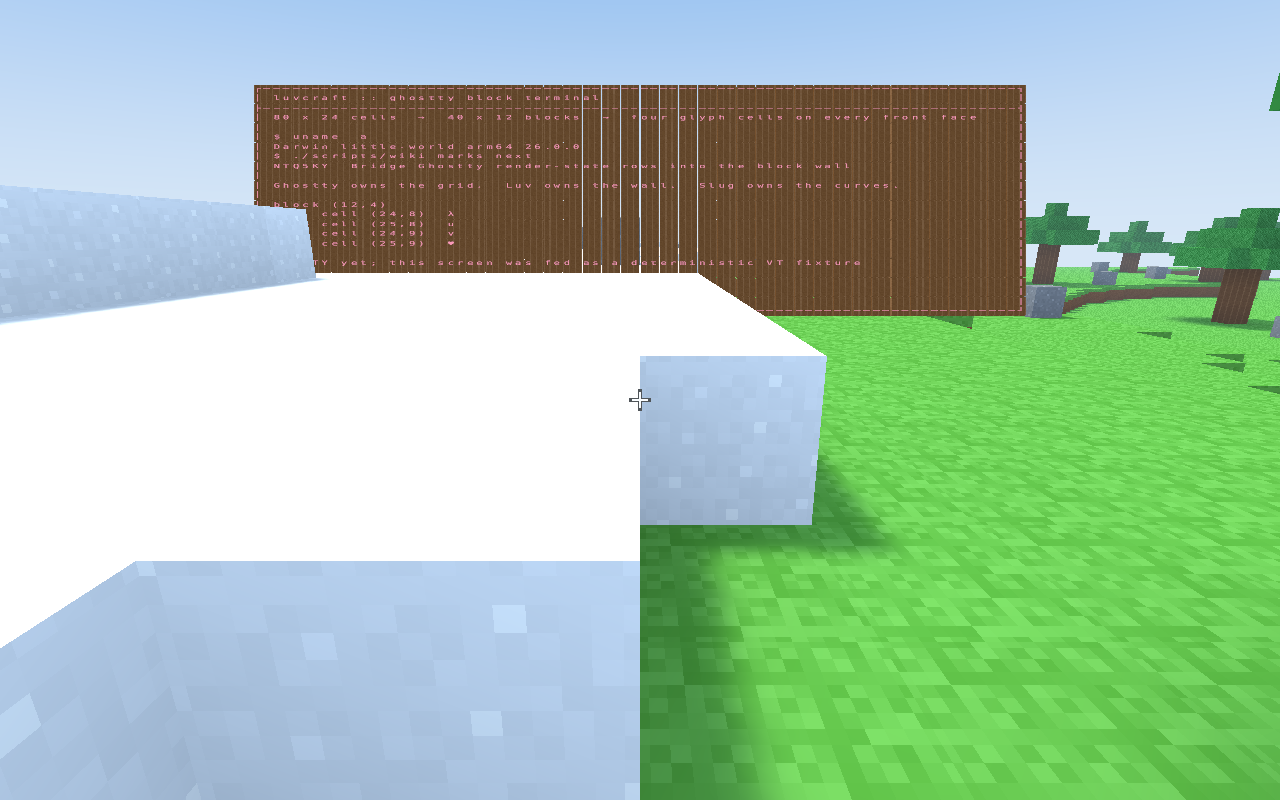
The result is useful negative evidence. The reduced 0.32-unit derived
bodies and their gaps do not belong to the authored voxel lattice, while a
literal one-world-unit body per tile makes the display absurdly large. The
screenshot is therefore historical proof of an exhausted design, not visual
evidence for the current terminal. #7ZM22R keeps the successful Ghostty and
Slug crossings but replaces the derived mini-block wall with real adjacent
world blocks and one fitted surface-wide terminal grid.
Done: the experiment made the scale and seam failure visible from an ordinary player view, and established that the glyph pass can share scene projection and depth. Its block/quadrant mapping is deliberately not retained as the terminal architecture.
Adjacent terminal-material blocks define one unified display surface #7ZM22R
The current implementation begins with ordinary authored voxel blocks of the
dedicated terminal material. When exposed faces of those blocks form a
maximal coplanar rectangular component, that rectangle has one derived
terminal-surface identity. Its native chunk meshes remain the solid display
body: the terminal overlay contributes only a Slug glyph population fitted
across the whole rectangle. Consequently adjacent block faces meet exactly
as ordinary terrain faces do. There are no derived bodies, inset cells, or
decorative gaps to make the terminal foreign to the world.
The font grid is independent of block count. An 80 x 24 viewport can fit
across an 8 x 5 block rectangle because the surface computes one physical
width and height, applies a margin, and selects the limiting font scale. No
voxel owns ten columns, four rows, or any other permanent cell subdivision.
The block rectangle gives the magic television its world identity; Ghostty's
viewport gives its changing screen content a separate finite domain.
Verified now:
- the terminal material is an authored, placeable block kind with its own graphite atlas tile and provisional surface emission;
- exact row-major viewport indexing and whole-surface fitting have executable tests;
- adjacency discovery accepts exposed rectangular components and rejects a rectangle after one constituent block is removed;
- the deterministic fixture crosses an owned Ghostty terminal before its characters become fitted Slug instances; and
- dependency stamps delay invalidation until the native owner chunk meshes are current, so old block geometry and old glyphs remain one last-known-good visible cohort rather than tearing across a publication boundary.
The present adjacency finder is intentionally a correctness scaffold, not the hot maintenance architecture. It builds coordinate lists and a hash table while discovering a surface and rescans its boundary after relevant authored chunk revisions. Opening a display and reconciling a changed dependency are cold enough for this proof; doing equivalent allocation or graph discovery per frame would be unacceptable. The frontier vocabulary in #K3PCP3, the compact work representation in #RR9ODK, and the publication discipline in #QHBZJZ are the route toward one reusable materialized adjacency system shared with light, liquids, fire, redstone-like networks, and later terminal-surface maintenance.
Visual acceptance remains open. The old screenshot above does not prove this new geometry looks good. A fresh visible luvcraft session should place a moderately sized rectangle, open the overlay, and inspect it from oblique and frontal angles at near, ordinary play, and long distances. The evidence gate is continuous real block geometry, stable depth and orientation, legible surface-wide fitting, and no flicker or stale-glyph cohort while editing an edge block.
Mentioned in: The derived 2 by 2 block wall exposed the wrong abstraction, Bridge styled Ghostty render-state rows into the block wall
Referenced from code: Create one owned Slug draw batch from caller-positioned The caller owns the semantic placement policy and supplies the dense instance
records. This is the shared GPU boundary for ordinary shaped runs and the
unified terminal surface in #7ZM22R.defun make-world-text-run-from-instances text.lisp:200 ↗
glyphs.
The terminal grid remains authoritative through Slug #I9U71F
Ghostty supplies grapheme clusters and cell occupancy, but not shaped glyphs. Luv must join those cells to the HarfBuzz and Slug boundary in #4G7064 without allowing proportional shaping to reflow the terminal. Cell coordinates and narrow, wide, or spacer roles remain authoritative. A wide spacer tail emits no glyph; backgrounds and decorations use cell-aligned geometry; a grapheme's outline is placed at its declared cell origin and clipped or scaled according to an explicit terminal font policy.
The simplest correct first representation is dense data per dirty row:
- the fixed cell presentation in #AI83XS, updated by contiguous row slice;
- glyph instances keyed by font, glyph ID, style, cell origin, and terminal advance;
- cell background, selection, underline, strike, overline, and cursor geometry; and
- narrow draw populations whose first policy may rebuild the visible grid as one batch.
The existing per-device Slug outline cache #U5X6DY is the natural resource owner. The atlas and instancing pass #AT7L3S has replaced the former one-texture-pair and one-draw-per-glyph proof, while #D4R1VX selects spatial bands and derives coverage scale in the fragment. A terminal will now make the next limits visible: atlas pages shared across overlapping glyph sets, pipeline reuse across rows, font fallback, row/run aggregation, and measured edge quality. Those are renderer iterations, not reasons to obscure the initial Ghostty-to-row boundary.
Mentioned in: A terminal is sharp at any distance because its glyphs are geometry
NEXT Bridge styled Ghostty render-state rows into the block wall #NTQ5KY
Intent: replace the formatter fixture bridge in #7ZM22R with world-native render-state rows, while keeping process and input concerns out of the first crossing. The unified surface-wide fit and native-body/Slug-overlay split remain projections of the resulting cell materialization.
Evidence: the current binding already owns a terminal and feeds arbitrary VT bytes; the Nix environment owns the exact shared library. Ghostty's pinned render API supplies dirty-row and cell iteration. The world overlay seam #0U22KN and the working Slug world-text path #QW7P96 already supply placement, depth-tested drawing, shaping, and device outline ownership. The finite domain #RD8AEI, fixed presentation #AI83XS, and compact projections #BIXI1P give the crossing a concrete luv-shaped representation without making cells objects.
The live Bash iteration establishes a deliberately coarser baseline without claiming this mark complete. PTY output marks its display dirty; the frame owner borrows Ghostty under the PTY lock, formats one complete plain-text snapshot, builds a complete dense instance candidate, and atomically replaces the old GPU instance buffer. Ordinary printable ASCII shares one stable Slug atlas, output bursts coalesce at the frame boundary, an empty screen emits no draw, and backend destruction carries replaced buffers past their last submission. Styling, backgrounds, cursor state, true dirty rows, and resize still require the render-state crossing named by this mark.
Done when: a fixed styled VT fixture produces visible Slug-rendered rows on the block wall, including cell backgrounds and cursor; Ghostty cells populate an exact domain-bound columnar materialization; a second unchanged render-state update performs no materialization or draw-population rebuild; changing one row publishes only that materialization slice even if the first compact draw policy rebuilds the small visible batch; resize replaces the domain coherently; and terminal, render-state, iterator, side-table, columnar, and GPU resources all have explicit release paths.
DONE Attach a live PTY independently of the render boundary #9OFAII
Intent: make the world terminal interactive without folding process ownership or callback reentrancy into its renderer. The PTY owner can now advance beside the render-state work rather than waiting behind it: both meet at the owned Ghostty terminal and neither needs the other's representation.
Evidence: the separate luv/terminal system now supplies one concrete
pty-device rather than a speculative device framework. Its worker owns the
child process and bidirectional PTY stream; a mailbox serializes caller input,
Ghostty's copied synchronous reply bytes, resize, and stop with PTY reads and
terminal mutation. Renderer-side snapshot work can borrow the terminal under
the same explicit lock. The device does not own the semantic terminal, so a
fixture, Lisp inspector, or later non-PTY producer can drive that terminal
without inheriting process machinery.
Focused cold tests exercise a shell exchanging text with the host, a cursor
position query which makes the complete child → PTY → Ghostty → response
callback → PTY → child round trip, matching TIOCSWINSZ and stty size with
Ghostty grid resize, natural child exit, forced shutdown, idempotent release,
and survival of the caller-owned terminal after device close. The child gets
a deliberate xterm-256color baseline rather than inheriting a headless
TERM=dumb development environment.
Keyboard input now follows the same portable boundary already used by McCLIM:
SDL translates its native ABI into canvas-key-event, and the optional
luv/terminal/canvas adapter projects that fact into Ghostty's W3C physical
key vocabulary. The PTY mailbox carries semantic key facts rather than stale
escape strings; its owner synchronizes Ghostty's reusable encoder from the
live terminal immediately before encoding. This preserves cursor application
mode and the later Kitty keyboard modes. The portable event now retains the
layout-produced character and its unshifted counterpart, which is enough for
ordinary Ctrl and shifted-key encoding without promoting SDL types into the
application vocabulary.
Observed completion: aiming at an authored terminal wall and pressing Tab
now creates its display, launches /bin/bash in the project's current
directory, and focuses it. A live Metal session sent pwd through
canvas-key-event and the Ghostty encoder, displayed /Users/mbrock/luv on
the wall, and published six successive output snapshots without stopping the
frame loop. Pressing Tab reached Bash completion; Shift-Tab is the separate
world unfocus gesture. The focused PTY and luvcraft suites exercise prompt
output, text and special-key input, terminal replies, resize, exit, dirty
notification, and release. Rich composed text input remains later device-side
work rather than a condition on this first playable Bash crossing.
(session focus)Enter modal interaction with FOCUS, suspending ordinary player input. This is the common session transition behind using a world terminal or book, mounting a vehicle, and other interactions described by #8JCMA5.
(session)Logical conjunction of tests and raw truth values.
(camera)(session)(focus session)Notify FOCUS that SESSION has entered its interaction mode.
A child PTY and the serialized IO path which drives one Ghostty terminal. The worker, mailbox, and terminal lock realize the single-owner flow in #K3KFGZ; the device deliberately does not own the semantic terminal.
An explicitly owned libghostty-vt terminal.
An explicitly owned reusable libghostty-vt keyboard encoder and event.
(name-and-options &body lane-descriptions)Define fixed columnar storage whose exact extent comes from one DOMAIN. Each lane has the same syntax as DEFINE-COLUMNAR-BUFFER. The generated MAKE-NAME constructor takes DOMAIN first, asks DOMAIN-CARDINALITY for its exact extent, checks the row declaration once, and allocates one specialized array per lane. The…
(device target-format string font-pathname shaped glyphs atlas center
world-units-per-em instance-data &key (label "world HarfBuzz Slug text"))Create one owned Slug draw batch from caller-positioned GLYPHS. The caller owns the semantic placement policy and supplies the dense instance records. This is the shared GPU boundary for ordinary shaped runs and the unified terminal surface in #7ZM22R.
How the children of a list are arranged.
(device descriptor)Asks the DEVICE for a handle to newly created instance of some object fulfilling the DESCRIPTOR.
Multiplication and scalar scaling.
The maximum of compatible quantities.
(&key role (stage :fragment) vertex-role label device layout vertex-module
vertex-buffers target-format target-blend primitive depth-stencil)Create and install a live mathematical render pipeline. VERTEX-MODULE is borrowed when VERTEX-ROLE is NIL and STAGE is not :VERTEX. Every module compiled from ROLE or VERTEX-ROLE is owned by the returned artifact and retired on replacement or explicit release.
(arguments)(artifact)(handle)Logically invalidate HANDLE immediately. Native teardown may be deferred until submitted work which captured HANDLE has completed.
Intent: cross #4G7064 from an isolated target into the actual luvcraft scene, with world placement, camera projection, scene depth, and alpha composition all participating in the same frame as terrain. make-world-text-run is now a semantic owner around dense HarfBuzz placement and vertex data. Its initial model…
Intent: make text runs cheap to reconstruct without hiding GPU lifetime inside glyph occurrences. make-world-text-glyph-cache is owned by the luvcraft session and tied to one device. It retains HarfBuzz results by canonical font path and exact string, and retains normalized, serialized Slug outlines by canonical…
The first embedded frames were made against the session's own canvas, context, and device, and each mirror owned a texture. Everything the frame drew -- draw-text*, draw-analytic-rounded-rectangle*, a decoded photograph as a pattern -- is rasterized into that texture at the size the frame was laid out at. The…
A sheet of paper showing a real document is a good probe, because a page is mostly small type and a reader knows immediately whether it is right. MuPDF hands back each typeset line with its box, size, and font, and the sheet drew those with draw-text* at positions scaled from PDF points. At two and a half metres the…
At minimum a finite domain answers: – how many sites exist; – which index type names one site; – how an index maps to a dense storage offset; and – how a dense offset maps back to an index. Additional capabilities should be explicit rather than presumed: – a neighborhood relation; – metric spacing or cell extent; –…
The visible terminal grid is a small, honest client of luv's finite-domain vocabulary. A terminal-grid-domain can own the current column and row counts, answer domain-cardinality with their product, map (x,y) to a row-major offset, and map an offset back to a cell coordinate. Row-major order is not just convenient…
A bundle is an eager answer to a finite question: for every site in this domain, what are the values of these fields? It is neither the entire world nor a universal database. A useful tentative contract for luv is: The schema should be closed by a class or other inspectable definition. A hash table into which…
One universal voxel bundle would combine values with very different causes and invalidation rules. A more legible arrangement might eventually include: – a mandatory block-content bundle; – a derived or incrementally maintained light bundle; – an optional fluid bundle; – ecological or geological readings over their…
The packed lighting frontier in #QS1ERH is the first small dynamic relative of a bundle. Its current sites are the ordinal domain [0, length); pushing and popping changes membership, while three parallel arrays materialize one entry, offset, and level reading for every member. The level buckets decide which buffer…
The intended division is not "CLOS outside, low-level code inside." It is more precise: – CLOS objects describe worlds, domains, field meanings, representations, policies, algorithms, and presentable categorical values; – generic dispatch selects an operation and storage representation once at an aggregate boundary;…
The block-particle population is the next honest client. Its block reference, position, velocity, size, age, and lifetime naturally form quantity-aware SoA lanes, but its update removes arbitrary expired rows while preserving survivor order, and overflow discards an oldest prefix. The current generated…
A planar rectangle of adjacent terminal-material blocks is a useful discover-once client. Starting from a placed or changed block face, the pass can traverse coplanar face neighbors of the same material, reserve a candidate surface identity, and collect bounds and membership. It then validates that the bounding…
The Haskell carrier deliberately favors clarity: Map memoization, a Map of Seq priority buckets, allocated lists of Plan values, traversable child layers, and monadic state. Those choices make the experiment easy to vary and test. They are not an acceptable inner-loop cost model for millions of voxel visits.…
The unification is real precisely because it is layered. We do not need one generic call per edge, or one object shape for every domain, to possess a shared language. We need stable compositional roles which can be lowered to the right concrete execution: The reusable words are concrete and already beginning to…
Text shaping and outline rendering meet at a deliberately narrow seam. shape-slug-text gives HarfBuzz the UTF-8 run and font bytes, then returns dense records containing glyph IDs, byte clusters, advances, and offsets in font units. It does not ask HarfBuzz to rasterize. The Slug side uses each glyph ID with…
The renderer needs data that survives the borrowed GhosttyRenderState cell iterators, but it does not need a second implementation of terminal semantics. A fixed columnar materialization over #RD8AEI should therefore retain only the normalized cell presentation consumed by later shaping and drawing. Ghostty remains…
Intent: remove the command and allocation multiplication caused by treating each glyph occurrence as an independently bound texture pair. create-world-text-glyph-atlas concatenates each distinct serialized outline into one RG16U band texture and one RGBA16F curve texture. Its location table maps the cached outline…
The shared shader language now carries derivative-x and derivative-y through direct Metal dfdx/dfdy and SPIR-V OpDPdx/OpDPdy. The fragment shader forms a screen gradient for each em axis and takes its reciprocal length as pixels-per-em. The same fragment normalizes its x/y outline coordinate, chooses one of the…
open-luvcraft-widget-lab constructs an embedded McCLIM frame against the world session's existing canvas, context, and device. encode-luvcraft-overlay lets that object contribute draws to the open scene pass, while handle-luvcraft-overlay-event lets the frontmost overlay consume an input event. The gadget…
The fixed cell materialization is still not a GPU draw list. One cell can emit no glyph, one glyph, or several glyphs for a grapheme; backgrounds may merge into spans; underlines and the cursor are different geometry with different lifetimes. Following #Y0TPND, membership policy should remain separate from the…
Luvcraft owns one optional modal focus independently of its overlay list. A focused object receives canvas events while ordinary walking, looking, block editing, jumping, and material selection are suspended. Entering or leaving focus clears held player input and releases relative-pointer capture, so a movement key…
libghostty-vt does not pull bytes from a process. Luv creates a PTY, starts a child, reads the master descriptor when ready, and passes each byte slice to ghostty_terminal_vt_write. Feeding bytes mutates the terminal immediately. It does not emit a damage callback; the host merely requests a later render update and…
The current implementation begins with ordinary authored voxel blocks of the dedicated terminal material. When exposed faces of those blocks form a maximal coplanar rectangular component, that rectangle has one derived terminal-surface identity. Its native chunk meshes remain the solid display body: the terminal…
Return the previous interaction all the way to the player's pose first. A direct focus-to-focus transition then borrows that same pose anew; recording before UNFOCUS would let its resume path consume the origin and leave the second interaction with nothing to return to.